Crémant: France's Other Sparkling Wine
A shared rulebook, eight sets of grapes, and a price that still undercuts the neighbor to the north. The category rewards anyone willing to read past the word on the label.
A Journey Through the Regions, Traditions, and Appellations That Defined Modern Winemaking

There is no way around it: France is the center of the wine world. Not because it produces the most wine (Italy sometimes claims that title) or because it occupies the most vineyard land (Spain does), but because France defined the vocabulary, the philosophy, and the classification systems that every other wine-producing nation has spent the last two centuries either emulating or reacting against. The concepts of terroir, appellation, and cru originated here. The grapes that dominate global wine production, including Cabernet Sauvignon, Merlot, Pinot Noir, Chardonnay, Sauvignon Blanc, and Syrah, all trace their genetic origins to French soil. Champagne is not merely a wine; it is a legal designation, a cultural symbol, and a method of production that sparkling wine producers worldwide measure themselves against.
The modern system of appellation laws (AOC) originated in France in the 1930s, creating legally protected geographic wine regions that influenced wine regulations worldwide.
In 2024, France remained the world's most valuable wine exporter at $12.7 billion, accounting for nearly a third of all global wine trade by value. Its 783,000 hectares of vineyards span a staggering range of climates and soils, from the cool chalk hills of the north to the sun-drenched limestone of the Mediterranean coast. For anyone serious about understanding wine, France is not just the starting point. It is the foundation.
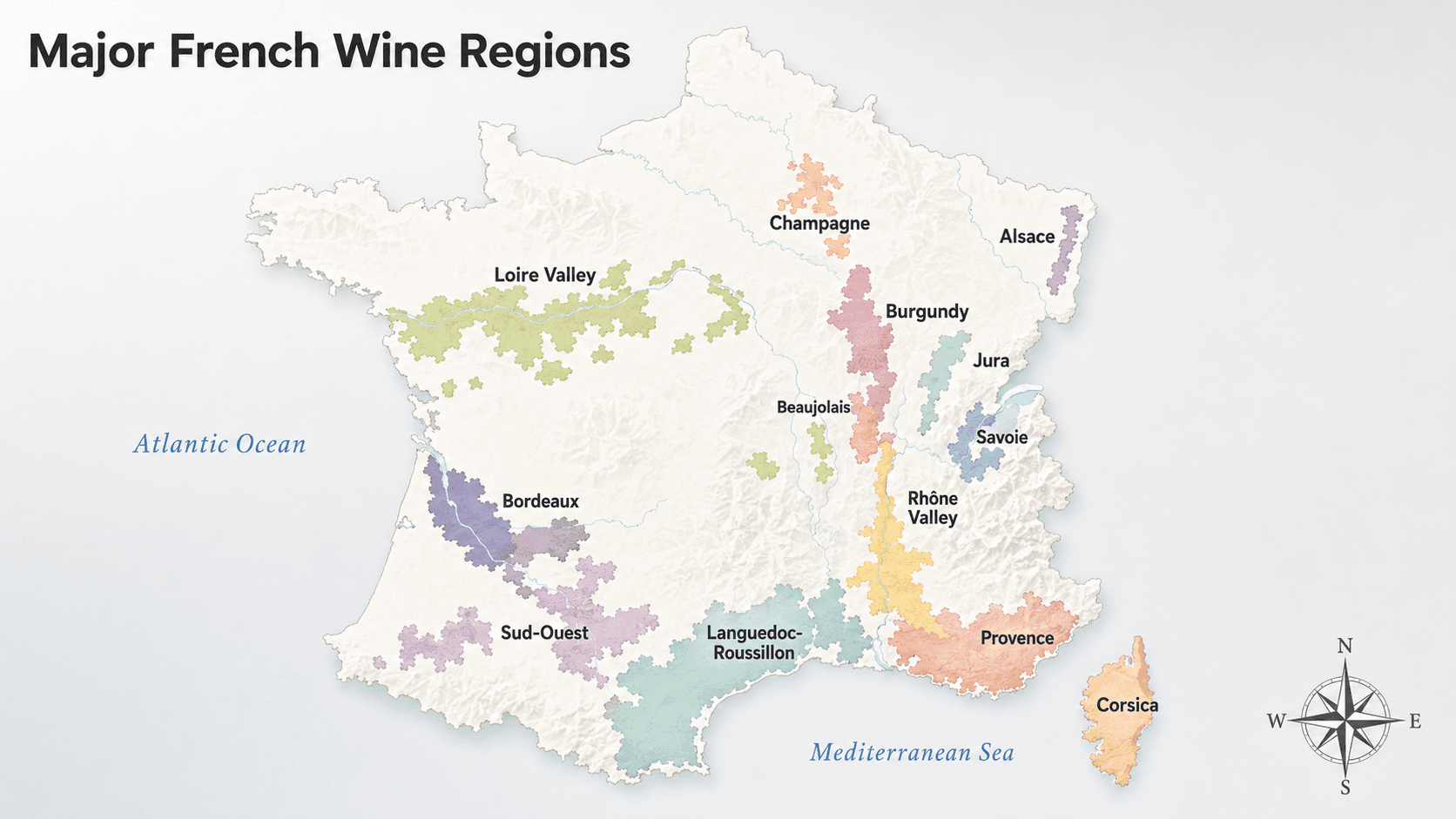
Winemaking arrived in France roughly 2,600 years ago, carried to the Mediterranean coast by Greek colonists who established the trading port of Massalia, present-day Marseille, around 600 BC. The Romans expanded viticulture dramatically, planting vineyards throughout Gaul as they pushed north along river valleys. By the first century AD, vineyards flourished in what we now call the Rhone Valley, Burgundy, and Bordeaux. When the Roman Empire collapsed, the Catholic Church preserved viticultural knowledge through its monasteries. Benedictine and Cistercian monks became the most meticulous vineyard custodians in medieval Europe, cataloging individual plots, observing how slight differences in soil and exposure affected wine quality, and effectively inventing what the French would later formalize as the concept of terroir.
The political history of France profoundly shaped its wine regions. The marriage of Eleanor of Aquitaine to Henry Plantagenet in 1152 made Bordeaux an English commercial outpost for three centuries, establishing the claret trade that still defines Bordeaux's export orientation. The Dukes of Burgundy cultivated a rival tradition centered on monastic precision and aristocratic prestige. Champagne's sparkling wine tradition emerged in the 17th century through the innovations of monks and merchants, though the popular myth that Dom Perignon "invented" Champagne is a romantic simplification.
France formalized its approach to wine regulation in 1935 with the creation of the appellation d'origine contrôlée (AOC) system, which governs everything from permitted grape varieties and maximum yields to vineyard boundaries and winemaking practices. This system, now administered under the broader European Protected Designation of Origin (PDO) framework, remains the most complex and layered quality classification in the wine world. It is the reason that French wine labels traditionally tell you where a wine is from rather than what grape it is made from, operating on the principle that place matters more than variety.
Bordeaux is France's largest fine wine region and one of the most recognizable wine names on earth. Located in southwestern France along the Gironde estuary and the Garonne and Dordogne rivers, Bordeaux in 2024 encompassed approximately 95,000 hectares of vineyards, down from 103,000 the previous year and 125,000 at the turn of the millennium. The decline is deliberate. Government-subsidized vine-removal programs have uprooted over 12,000 hectares since 2023 to address chronic overproduction and falling demand, particularly for entry-level red wines.
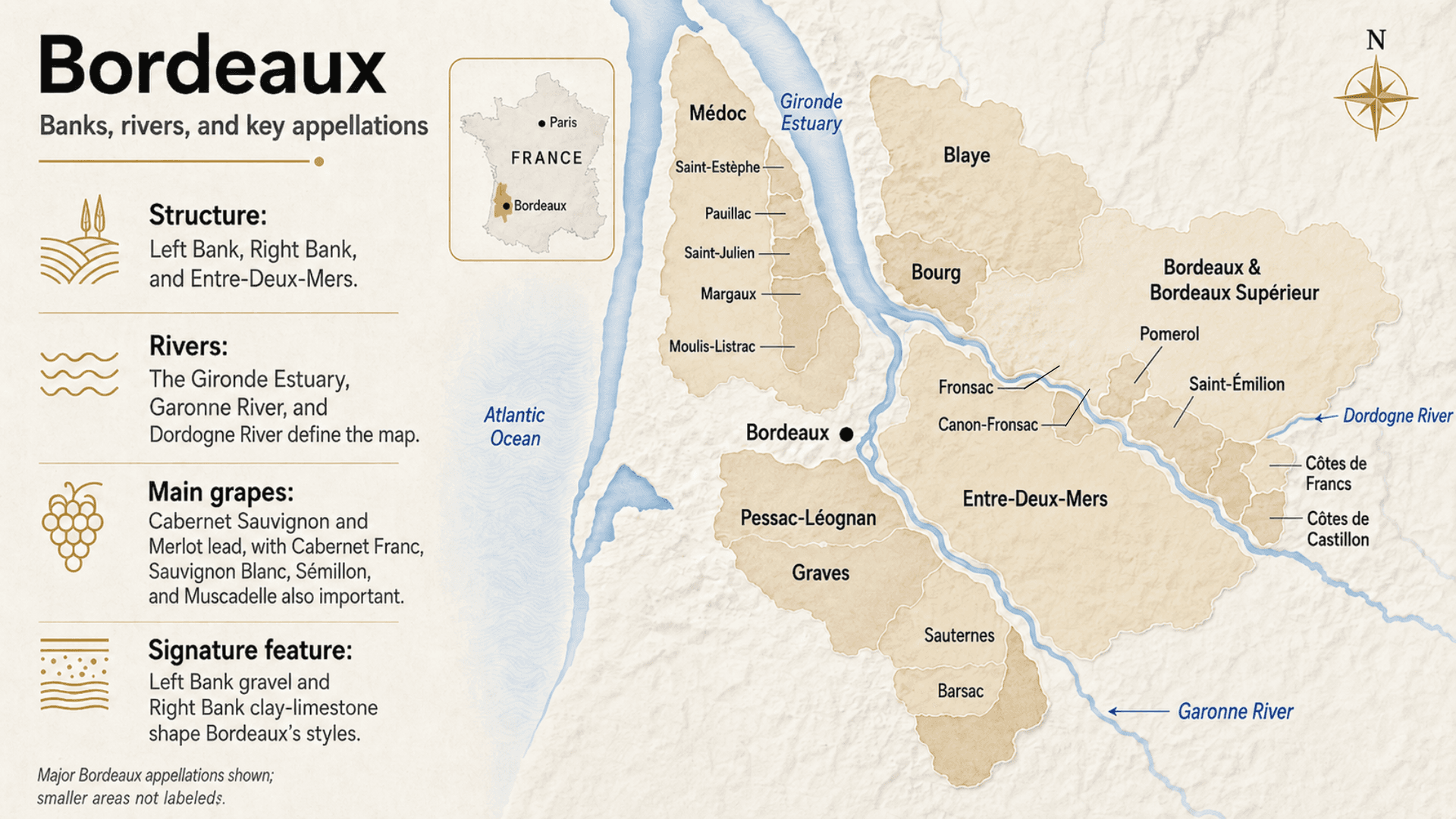 Bordeaux produces over 700 million bottles of wine annually, making it one of the largest and most influential fine wine regions in the world.
Bordeaux is fundamentally a blending region. On the Left Bank, which includes the famous communes of Pauillac, Margaux, Saint-Julien, and Saint-Estèphe in the Medoc peninsula, Cabernet Sauvignon dominates blends and produces wines of firm tannic structure, cassis, graphite, and cedar that can age for decades. The Right Bank, centered on Saint-Emilion and Pomerol, favors Merlot on its clay and limestone soils, yielding wines of plush fruit, roundness, and generosity. Cabernet Franc plays a supporting but increasingly respected role, particularly in Saint-Emilion.
The 1855 Classification, commissioned by Napoleon III for the Paris Exposition, ranked Bordeaux's finest estates into five tiers of Crus Classes, or Classified Growths, based on price and reputation. The five First Growths (Premiers Crus) of the original classification are Château Lafite Rothschild, Château Latour, Château Margaux, Château Haut-Brion, and Château Mouton Rothschild (elevated from Second Growth in 1973). This hierarchy, though it has barely changed in 170 years, still heavily influences pricing and prestige. Separate classification systems govern Saint-Emilion (revised periodically, most recently in 2022) and the sweet wines of Sauternes, where Chateau d'Yquem stands alone as the sole Premier Cru Superieur.
Bordeaux is navigating what many observers describe as its most serious crisis since phylloxera. Domestic French red wine consumption has fallen steadily for decades. Exports to China, which represented 20% of Bordeaux's shipments in 2017, collapsed after geopolitical tensions. The United States is now Bordeaux's largest export market at approximately EUR 340 million in 2024. The region produced only 3.3 million hectoliters in 2024, its lowest volume since 1991. Yet for all these challenges, the top classified estates continue to produce wines of extraordinary quality, and Bordeaux's diversity, from humble Bordeaux Superieur to legendary First Growths, from bone-dry whites to the honeyed dessert wines of Sauternes, remains unmatched by any single region on earth.
Many of the world’s most important grape varieties originate from France, including Cabernet Sauvignon, Chardonnay, Pinot Noir, Sauvignon Blanc, Syrah, and Merlot.
If Bordeaux is the public face of French wine prestige, Burgundy is its soul. Stretching from Chablis in the north through the Côte d'Or, the Cote Chalonnaise, and the Maconnais to Beaujolais in the south, Burgundy is built on two grapes: Pinot Noir for reds and Chardonnay for whites. This radical simplicity, two varieties across a patchwork of hundreds of precisely delineated vineyards, makes Burgundy the purest expression of the terroir concept anywhere in the world. The same grape, grown by the same producer, can taste fundamentally different depending on which side of a dirt path the vines sit on.
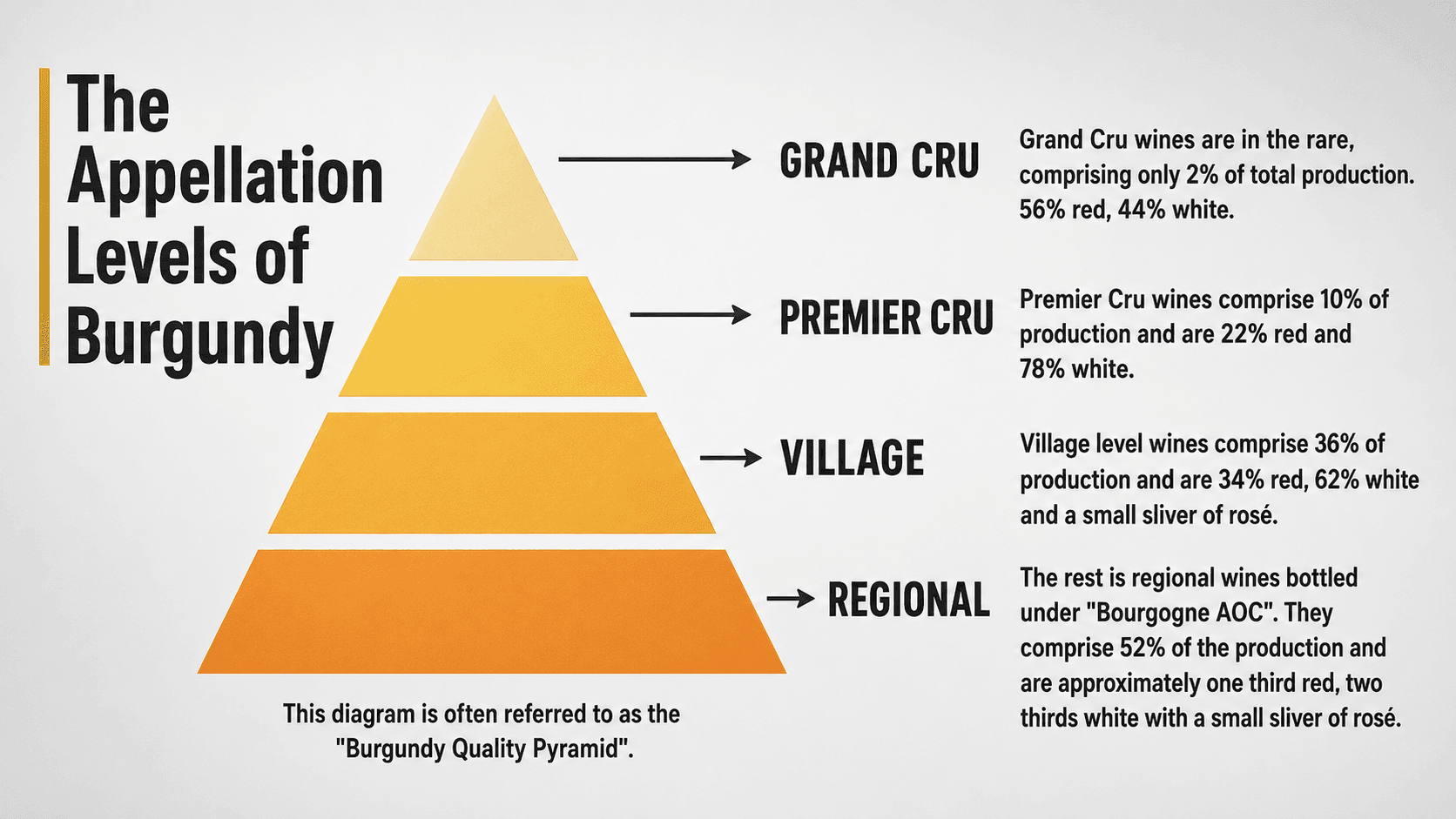
Burgundy's classification system is a four-tier hierarchy based entirely on vineyard site. At the top, Grand Cru vineyards represent just 1% of total production and include the most celebrated names in wine: Romanee-Conti, La Tache, Richebourg, Chambertin, Montrachet, and Corton-Charlemagne. There are 33 Grand Cru vineyards in the Côte d'Or. Below them, 640 Premier Cru climats account for roughly 10% of production. Village wines (37%) carry the name of their commune, such as Gevrey-Chambertin, Meursault, or Volnay. Regional wines (52%), labeled simply Bourgogne Rouge or Bourgogne Blanc, can come from anywhere in the region.
The Côte d'Or, Burgundy's golden slope, is the heart of the matter. Its northern half, the Côte de Nuits, contains 24 of the 25 red Grand Cru vineyards and produces Pinot Noir of legendary depth, complexity, and longevity. Its southern half, the Côte de Beaune, is the capital of white Burgundy, home to Montrachet and Corton-Charlemagne, producing Chardonnay of extraordinary richness, mineral intensity, and aging potential. Chablis, located 100 kilometers to the northwest on Kimmeridgian limestone and clay, produces a distinctly different style of Chardonnay: lean, steely, and mineral-driven, often with little or no oak influence. Beaujolais, made from Gamay on granite soils, ranges from the light, fruity Beaujolais Nouveau to the structured, age-worthy wines of the ten Cru villages, including Morgon, Moulin-a-Vent, and Fleurie.
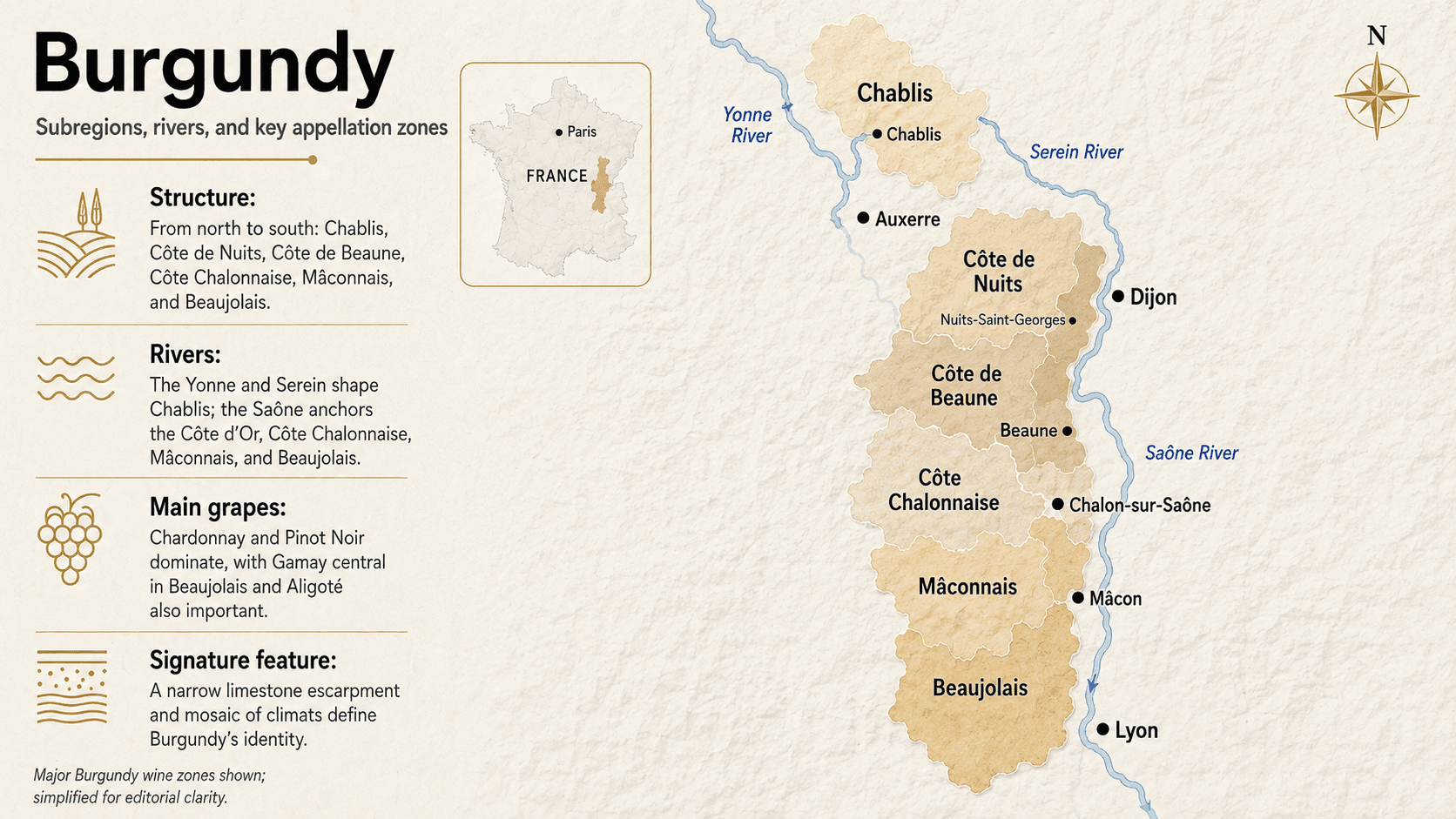 Here is a look at the greater Burgundy region.
Burgundy produces some of the most expensive wines on the planet. The Romanee-Conti Grand Cru vineyard, a monopole of Domaine de la Romanee-Conti covering just 1.81 hectares, produces fewer than 500 cases annually, with bottles regularly commanding tens of thousands of dollars. The broader Burgundy market, even at the village and regional levels, has experienced significant price inflation over the past two decades, driven by tiny production volumes, global demand, and a series of short harvests. The 2024 vintage saw a projected 45% rebound after devastating mildew losses in 2023, but Burgundy's structural scarcity ensures that its best wines will remain among the most sought-after and least accessible in the world.
Champagne is the world's most famous sparkling wine and, from a regulatory standpoint, the only one that legally bears the name. Wines labeled Champagne must come exclusively from the appellation in northeastern France, roughly 150 kilometers east of Paris, where production is concentrated around the cities of Reims and Épernay. The region's cool continental climate and chalk subsoil, the legacy of an ancient seabed, produce base wines of high acidity and delicate fruit that are ideally suited to the traditional method of secondary fermentation in bottle, known as méthode traditionnelle or méthode champenoise. The chalk also serves a practical function beyond viticulture, providing the deep, naturally cool cellars in which Champagne ages on its lees for years, gradually developing the toasted, autolytic complexity that distinguishes the category from sparkling wines produced anywhere else in the world.
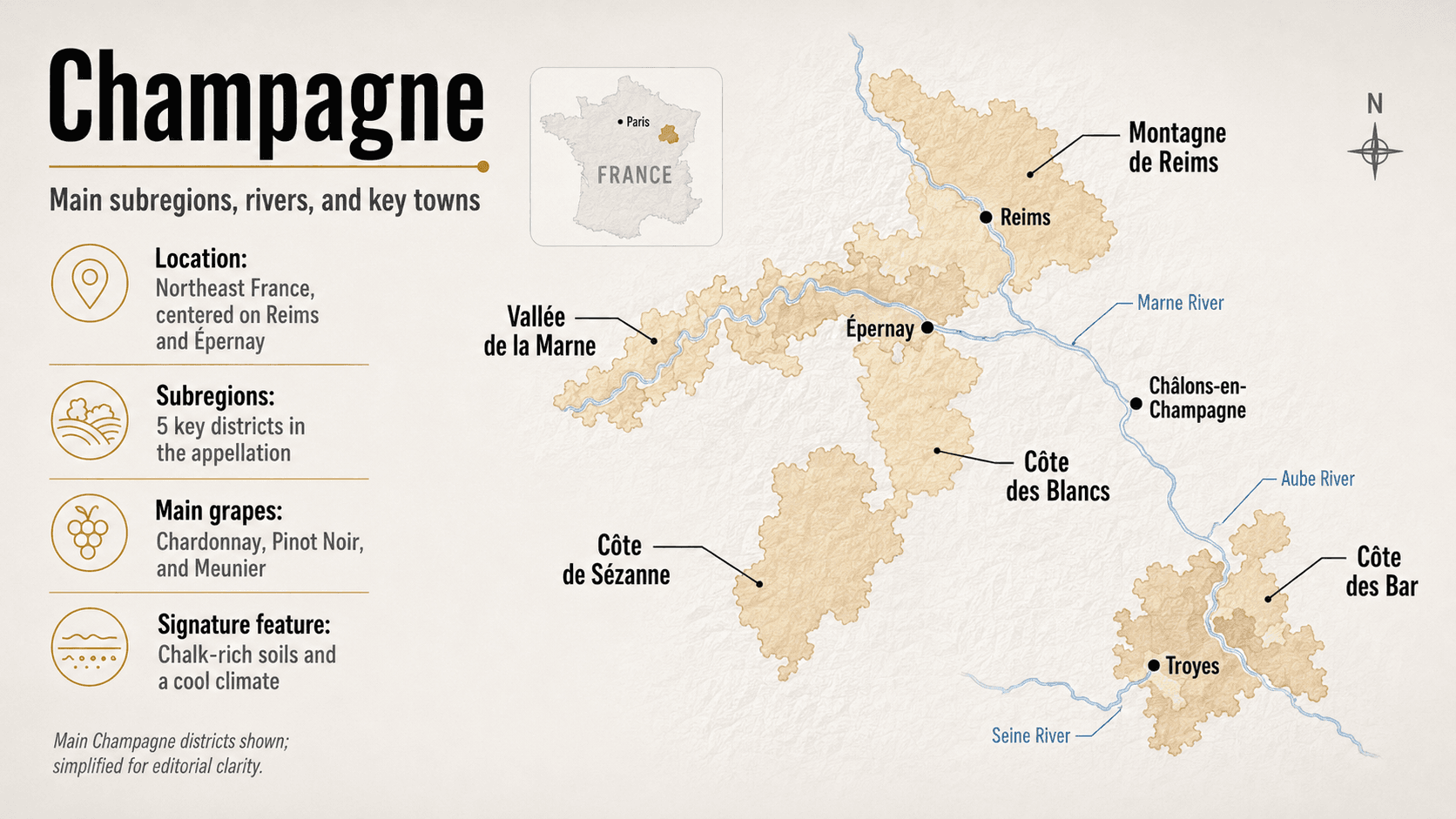 Here is an overview of the Champagne region.
The three principal grapes are Chardonnay, Pinot Noir, and Pinot Meunier, typically blended across multiple vineyards and often across multiple vintages to maintain a consistent house style. A Blanc de Blancs is produced entirely from Chardonnay, yielding a lean, citrus-driven expression, while a Blanc de Noirs comes from the red grapes Pinot Noir and Pinot Meunier, pressed gently to avoid color extraction. Vintage Champagne is produced only in exceptional years and must age a minimum of three years on the lees, though many prestige cuvées rest for a decade or more before release. Rosé Champagne is made either by blending a small proportion of still red wine into the base or by brief skin contact with Pinot Noir, an unusual exception in French wine law, which generally prohibits the blending of red and white grapes to produce a pink wine.
The Champagne market is dominated by large houses, known as maisons, such as Moët & Chandon, Veuve Clicquot, Krug, Dom Pérignon, Louis Roederer, and Bollinger, which purchase grapes from thousands of growers across the region and blend them into recognizable brand identities maintained across vintages. In recent decades, however, grower Champagnes, labeled RM for Récoltant-Manipulant, have gained enormous critical and commercial momentum, offering single-vineyard expressions and terroir-driven styles that represent a philosophical counterpoint to the blending traditions of the major houses. The Comité Champagne, the regulatory body representing more than 16,000 growers and roughly 350 houses, oversees the appellation through strict controls on yields, aging, pressing rates, and labeling, balancing supply against market demand in a way that other French regions have struggled to replicate.
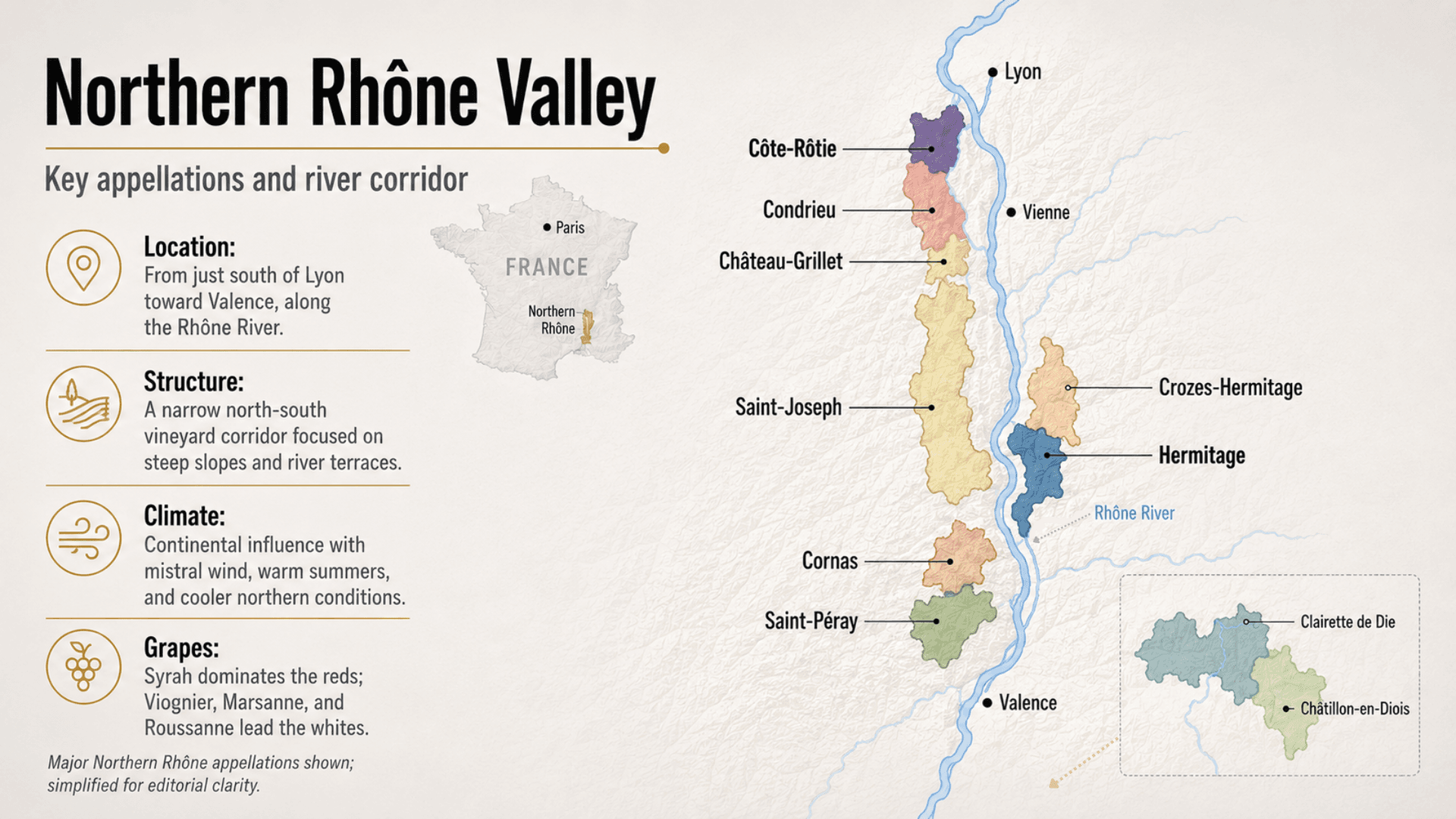
The Rhône Valley stretches from the city of Lyon south to Avignon and divides into two fundamentally different regions. The Northern Rhône is a narrow corridor of steep, terraced granite hillsides where Syrah is the sole red grape, producing wines of remarkable intensity, pepper, dark fruit, smoked meat, and violets. Côte-Rôtie, Hermitage, and Cornas are the most prestigious Northern Rhône appellations, producing reds that rival the finest wines of Bordeaux and Burgundy in quality and aging potential. Condrieu, made from Viognier on precipitous slopes, produces one of France's most distinctive and aromatic whites.
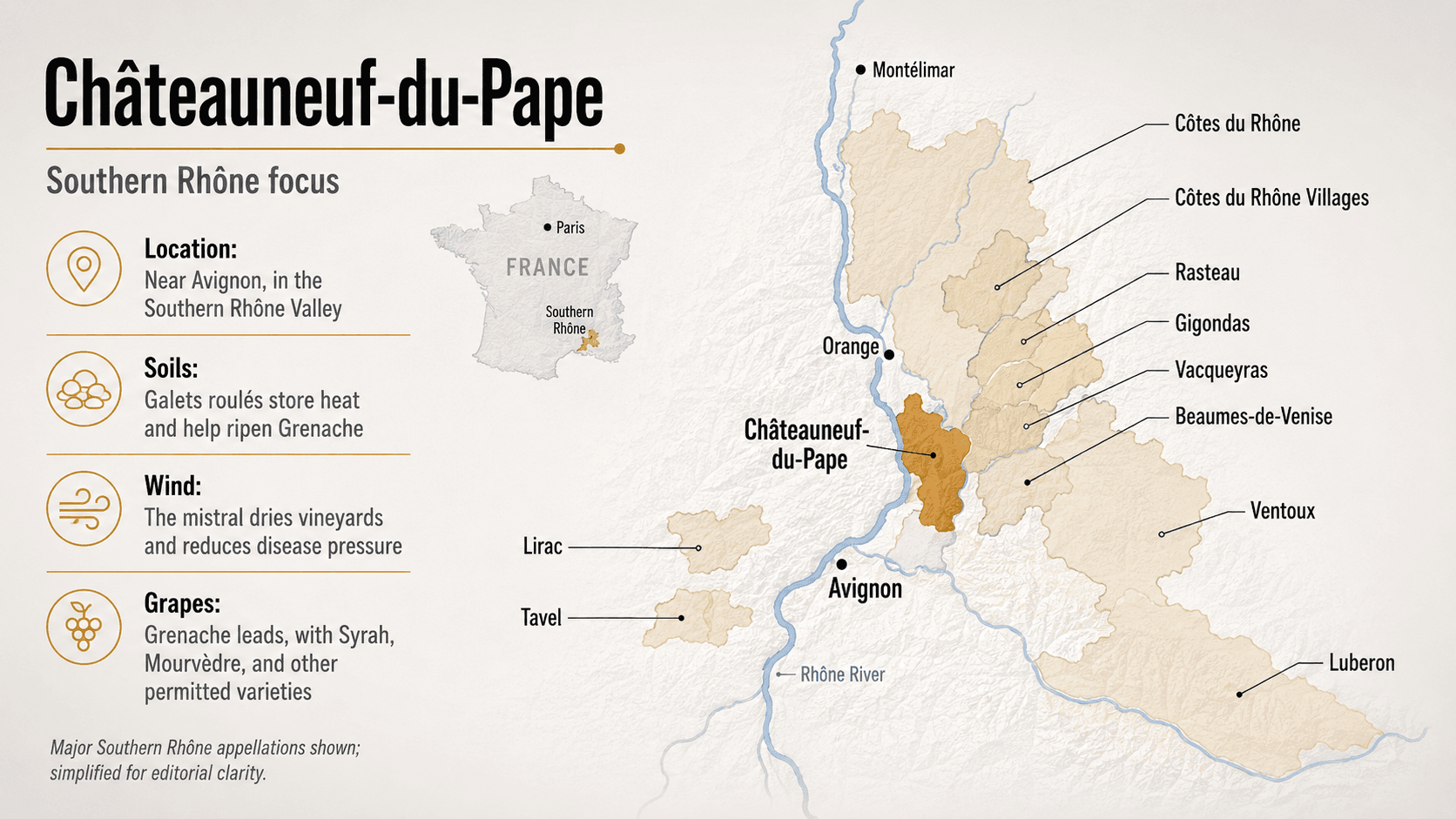
The Southern Rhône is broader, warmer, and Mediterranean in character. Châteauneuf-du-Pape, its most famous appellation, permits an extraordinary 13 grape varieties in its blends (18 when counting color variations), though Grenache typically dominates, supplemented by Syrah, Mourvèdre, and Cinsault. The wines are rich, warm, and generous, with flavors of ripe red fruit, garrigue (the wild herbs of the Provençal landscape), leather, and spice. Gigondas and Vacqueyras offer similar style at more accessible price points. Côtes du Rhône, the regional appellation, is one of the best values in French wine, producing reliably satisfying reds, whites, and roses.
The Loire Valley stretches across western France along the Loire River and its tributaries, forming one of the country’s largest and most varied wine regions. The river helps shape local temperatures, humidity, vineyard exposure, and historic trade routes, while the climate gradually shifts from maritime influence near the Atlantic to more continental conditions farther inland. White wine defines much of the Loire’s identity. Melon de Bourgogne produces the lean, saline wines of Muscadet, Chenin Blanc creates dry, sparkling, sweet, and remarkably age-worthy wines across Anjou, Saumur, Savennières, and Vouvray, and Sauvignon Blanc reaches its most famous expressions in Sancerre and Pouilly-Fumé.
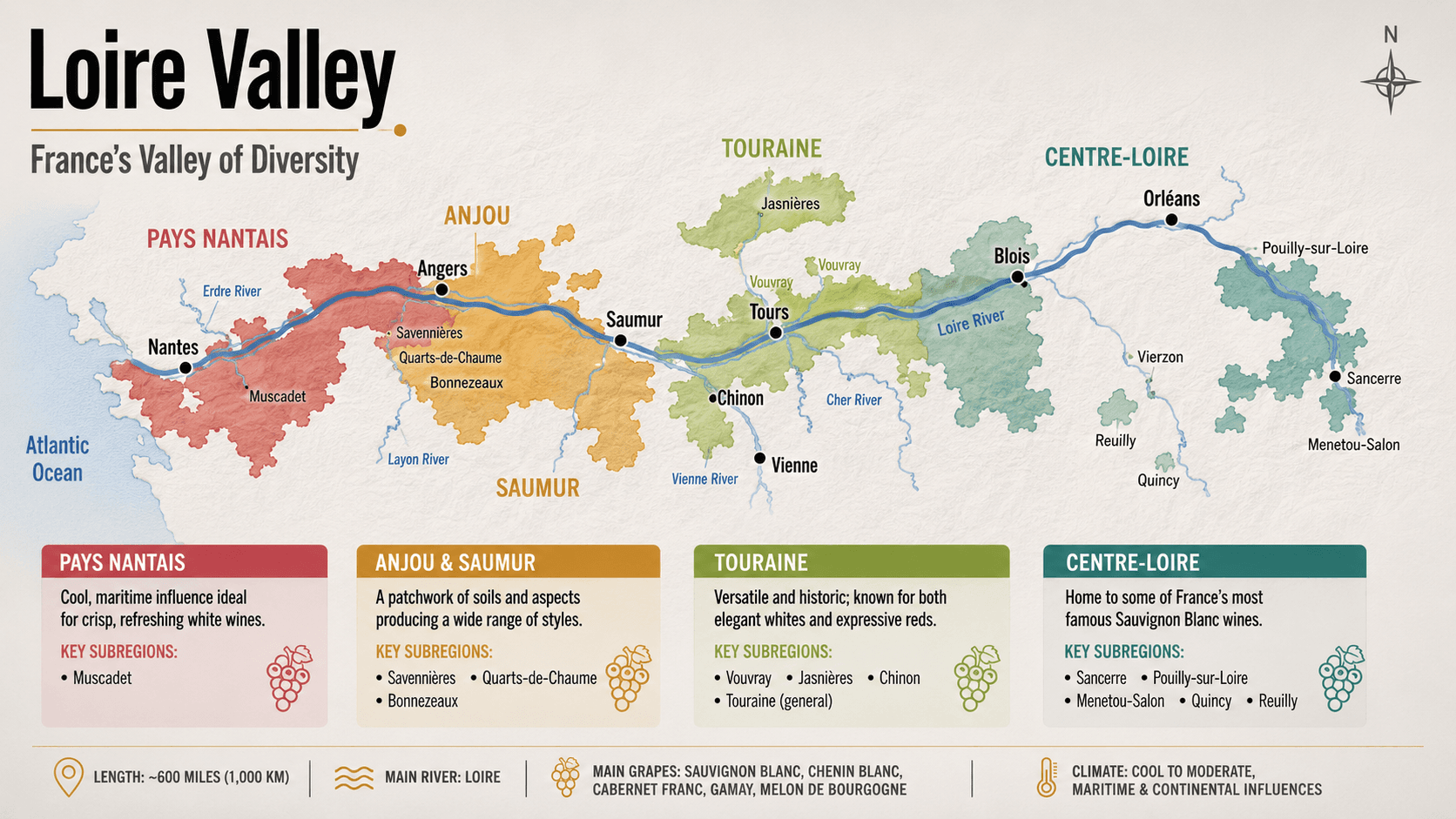
Vouvray and Sancerre may be the region’s best-known appellations, but the Loire is far broader than those two names suggest. Cabernet Franc drives the fragrant, savory reds of Chinon, Bourgueil, and Saumur-Champigny, while Gamay, Pinot Noir, Grolleau, and Côt contribute to the region’s extensive range of reds and rosés. Sparkling Crémant de Loire, sweet wines from the Coteaux du Layon, mineral whites from Savennières, and fresh coastal Muscadet all belong to the same river system. The Loire’s real strength is diversity: few regions can offer so many grapes, styles, price points, and food-friendly wines within one connected landscape.
Pressed against the German border and sheltered from Atlantic rain by the long rampart of the Vosges mountains, Alsace makes some of France's most distinctive white wines under one of its driest skies. Colmar, the regional capital, ranks among the least rainy cities in the country, and that warmth and light give the four noble grapes their voice: racy, age-worthy Riesling; perfumed Gewürztraminer; broad, spicy Pinot Gris; and delicate Muscat. Unlike most of France, Alsace built its identity on naming the grape on the label, a Germanic habit born of centuries of shifting borders. The region also bottles a wealth of single-vineyard lieux-dits, two prestige late-harvest styles in Vendange Tardive and Sélection de Grains Nobles, and a torrent of sparkling Crémant d'Alsace, which now accounts for more than a third of everything Alsace produces.
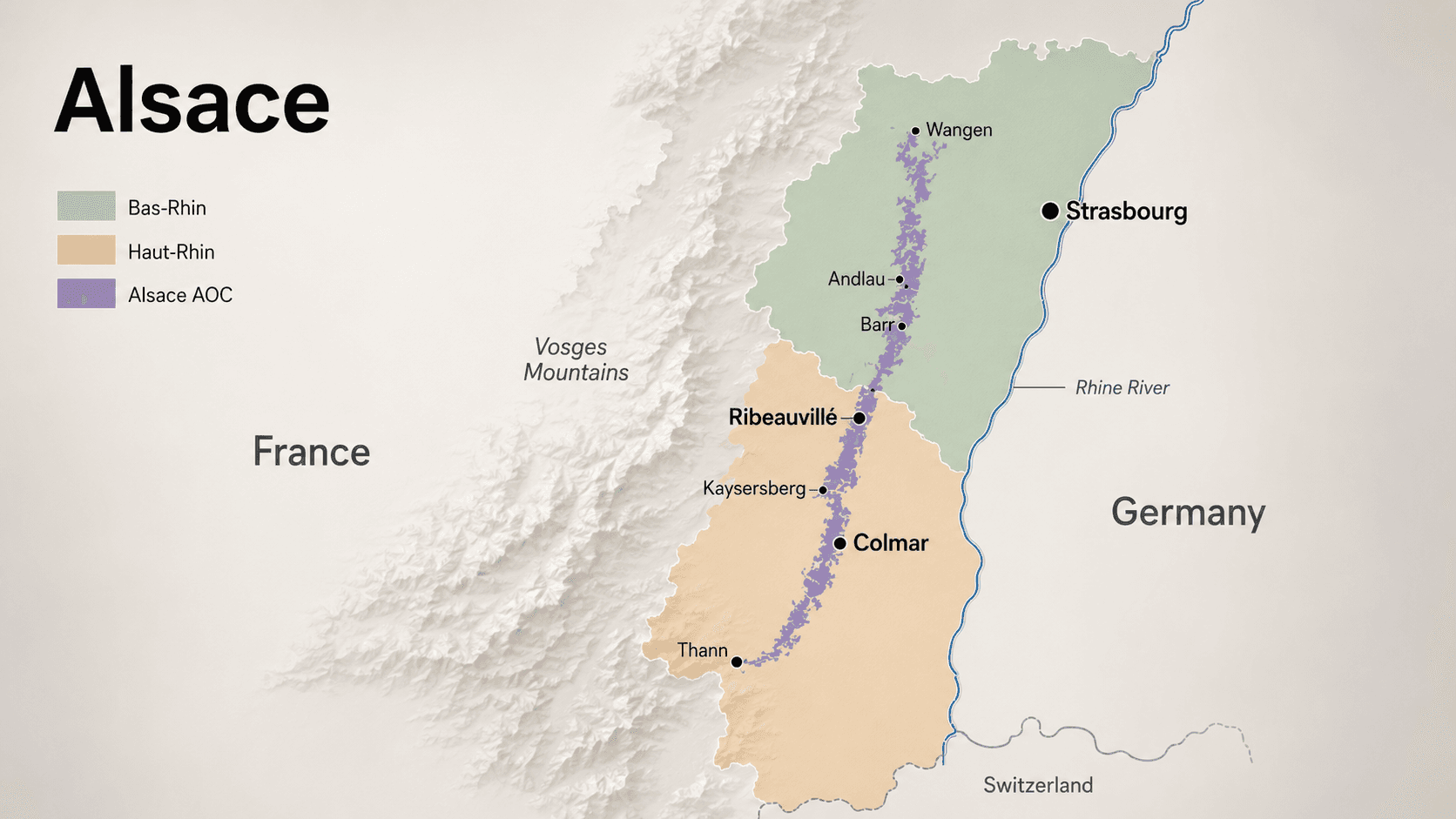 Alsace is defined by aromatic white wines, a dry continental climate, and remarkable geological diversity. The region's position between the Vosges Mountains and the Rhine River creates favorable growing conditions that preserve acidity while allowing full ripening.
At the summit sit the 51 Alsace Grand Cru vineyards, delimited between 1975 and 2007 and recognized since 2011 as independent appellations, each with its own rules of soil, slope, and yield. For decades these were reserved almost exclusively for the four noble whites, but the rules are loosening. Since July 2024, Pinot Noir, the region's only permitted red grape, may be bottled as Grand Cru from three sites, Kirchberg de Barr, Hengst, and Vorbourg, a quiet concession to a warming climate. A long-discussed Premier Cru tier, which would elevate the most consistent lieux-dits to a rank just below Grand Cru, remains under review by the INAO after more than a decade of lobbying. Even the iconic tall flute bottle is no longer mandatory, freed up by a 2024 rule change. Alsace, in short, is a settled classic learning to bend.
East of Burgundy, climbing the foothills known as the Revermont, the Jura is one of France's smallest and most idiosyncratic vineyards, barely 2,000 hectares strung along a 70-kilometer geological fault from Salins-les-Bains to Saint-Amour. Just five grapes are permitted: Chardonnay and the thick-skinned local star Savagnin for the whites, and Poulsard (also spelled Ploussard), Trousseau, and Pinot Noir for the pale, ethereal reds, with Poulsard alone covering roughly four-fifths of red plantings. Four geographic appellations map the region, Arbois (among France's first AOCs, granted in 1936), the broad Côtes du Jura, tiny L'Étoile, and Château-Chalon, alongside three product appellations: the Macvin du Jura, a mistelle of grape must and local marc; the increasingly popular sparkling Crémant du Jura; and the Marc du Jura brandy.
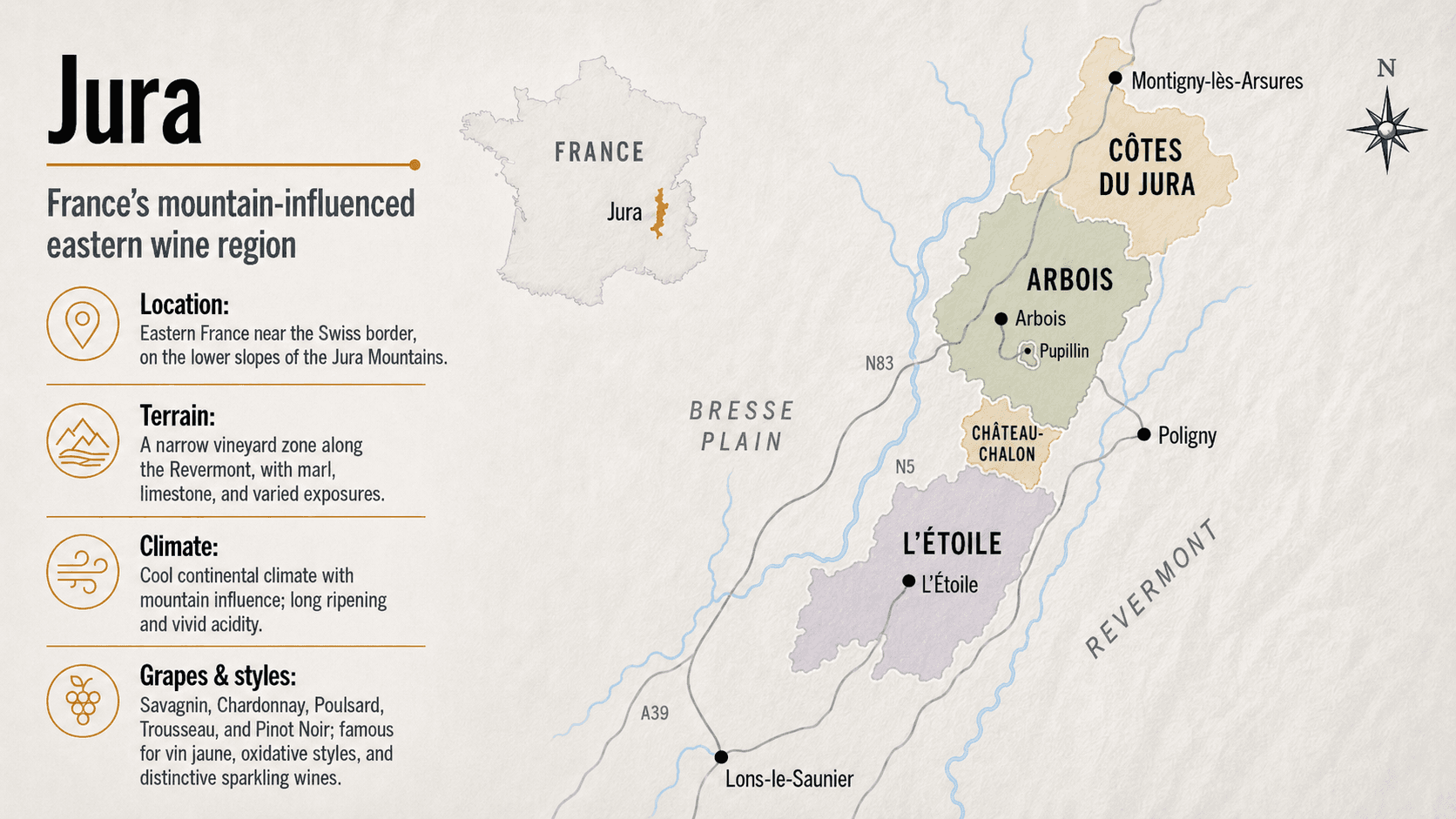
The Jura's signature is vin jaune, or "yellow wine," and it is unlike almost anything else in France. Savagnin is aged in barrel for a minimum of six years and three months without topping up the cask, allowing a film of yeast called the voile to form on the surface, much as flor does in the sherry cellars of Jerez. The result is a bone-dry wine of startling power and savor, with notes of walnut, curry spice, and dried apple, bottled in the squat 62-centiliter clavelin said to represent what remains of a liter after the long, evaporative aging. The hilltop village of Château-Chalon is so devoted to the style that its entire appellation produces nothing else. For sweetness, growers dry their finest bunches on racks to make the honeyed vin de paille. Few regions of this size offer so wide a palette.
Further south, the alpine region of Savoie produces crisp white wines from indigenous varieties found almost nowhere else, principally Jacquère and Altesse, the latter known locally as Roussette, alongside the spicy red Mondeuse. These light, mineral wines have long served as the natural companion to the region's mountain cheeses and traditional dishes.
Provence stretches along the Mediterranean coast in southeastern France and ranks among the oldest wine producing regions in the country, with viticulture dating to Greek colonization more than 2,500 years ago. The region has become globally synonymous with dry rosé, which accounts for roughly 90 percent of its production and has evolved from a local summer staple into an international lifestyle phenomenon.
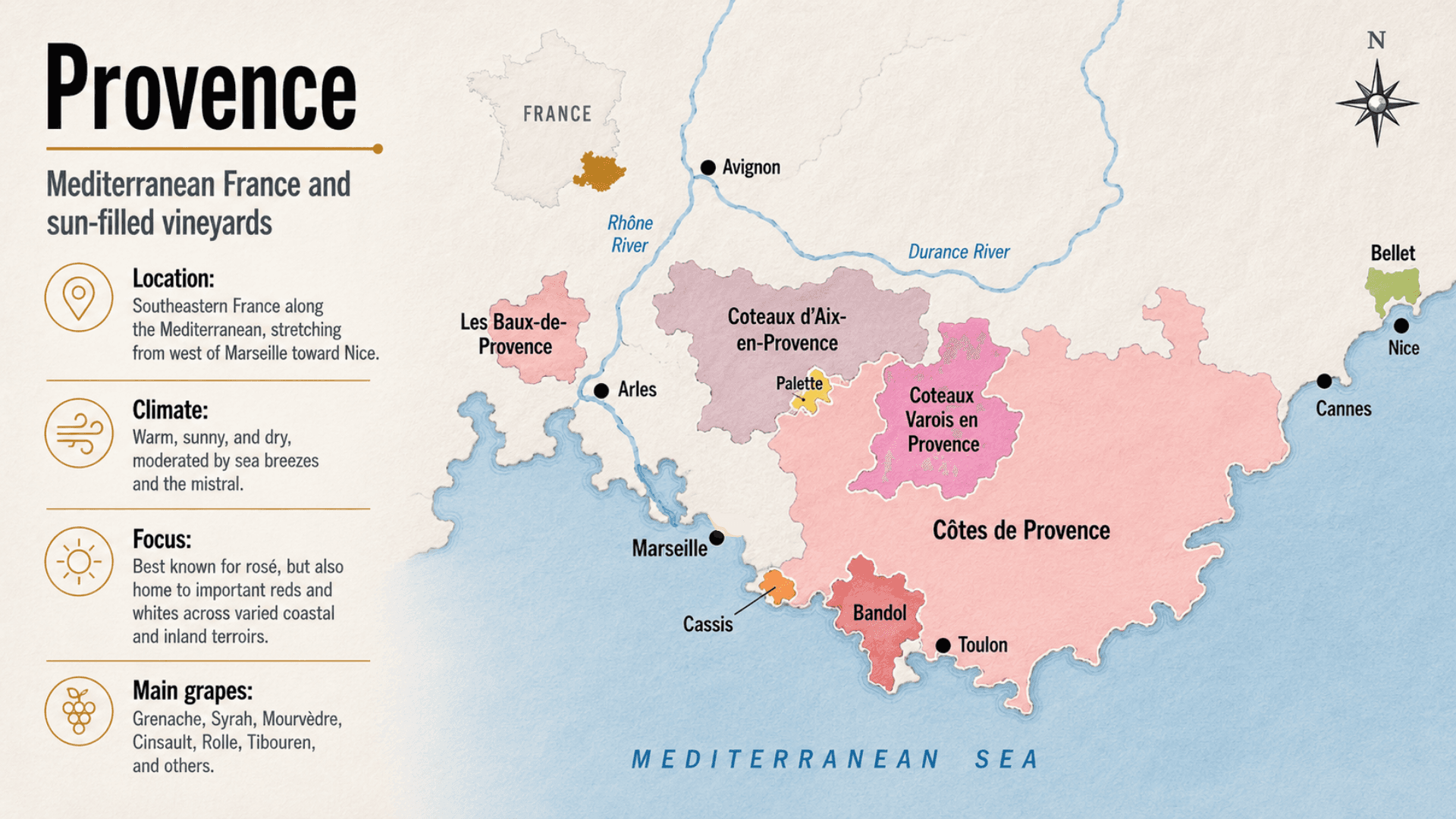
Pale in color, dry on the palate, and built around Grenache, Cinsault, Mourvèdre, Syrah, and the indigenous Tibouren, Provençal rosé is produced across appellations that include Côtes de Provence, Coteaux d'Aix-en-Provence, and Coteaux Varois en Provence. Yet to reduce Provence to rosé alone is to overlook its most serious red wines, produced in the small coastal appellation of Bandol. There, Mourvèdre achieves some of its finest expression outside of Spain, yielding densely structured reds capable of aging for decades. Smaller appellations such as Cassis, Bellet, Palette, and Les Baux de Provence add further dimension to a region whose reputation extends well beyond its famous pink wines.
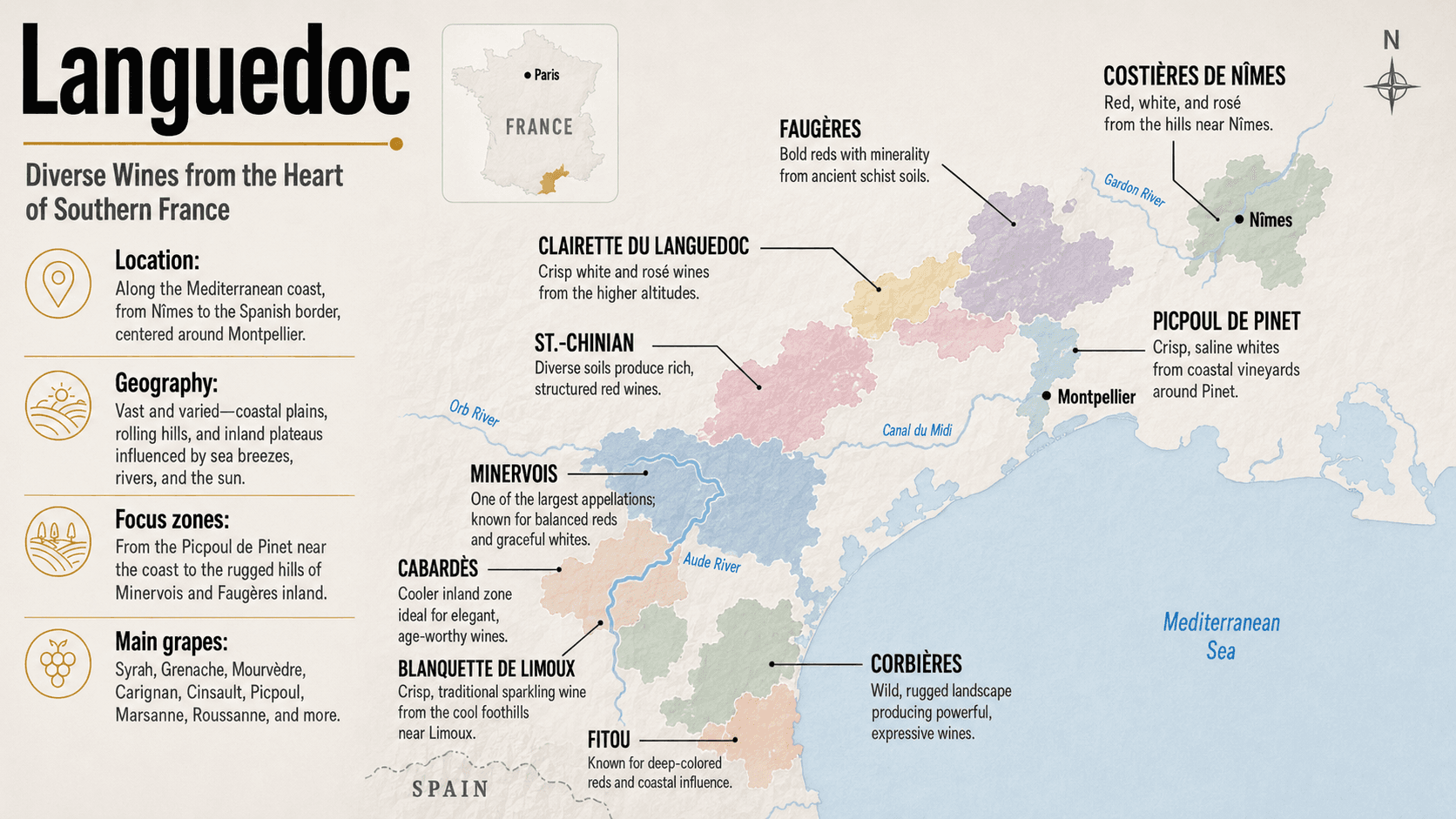
West of Provence, the Languedoc sweeps along the Mediterranean coast in an enormous crescent and comprises the largest vineyard area in France. Long dismissed as a source of cheap bulk wine, the region has undergone a remarkable quality revolution over the past three decades, with appellations including Corbières, Minervois, Faugères, Saint-Chinian, and Pic Saint-Loup now producing serious reds from Syrah, Grenache, Mourvèdre, and old-vine Carignan. Limoux holds the historical distinction of producing Blanquette de Limoux, widely considered the world's oldest sparkling wine and predating Champagne by more than a century.
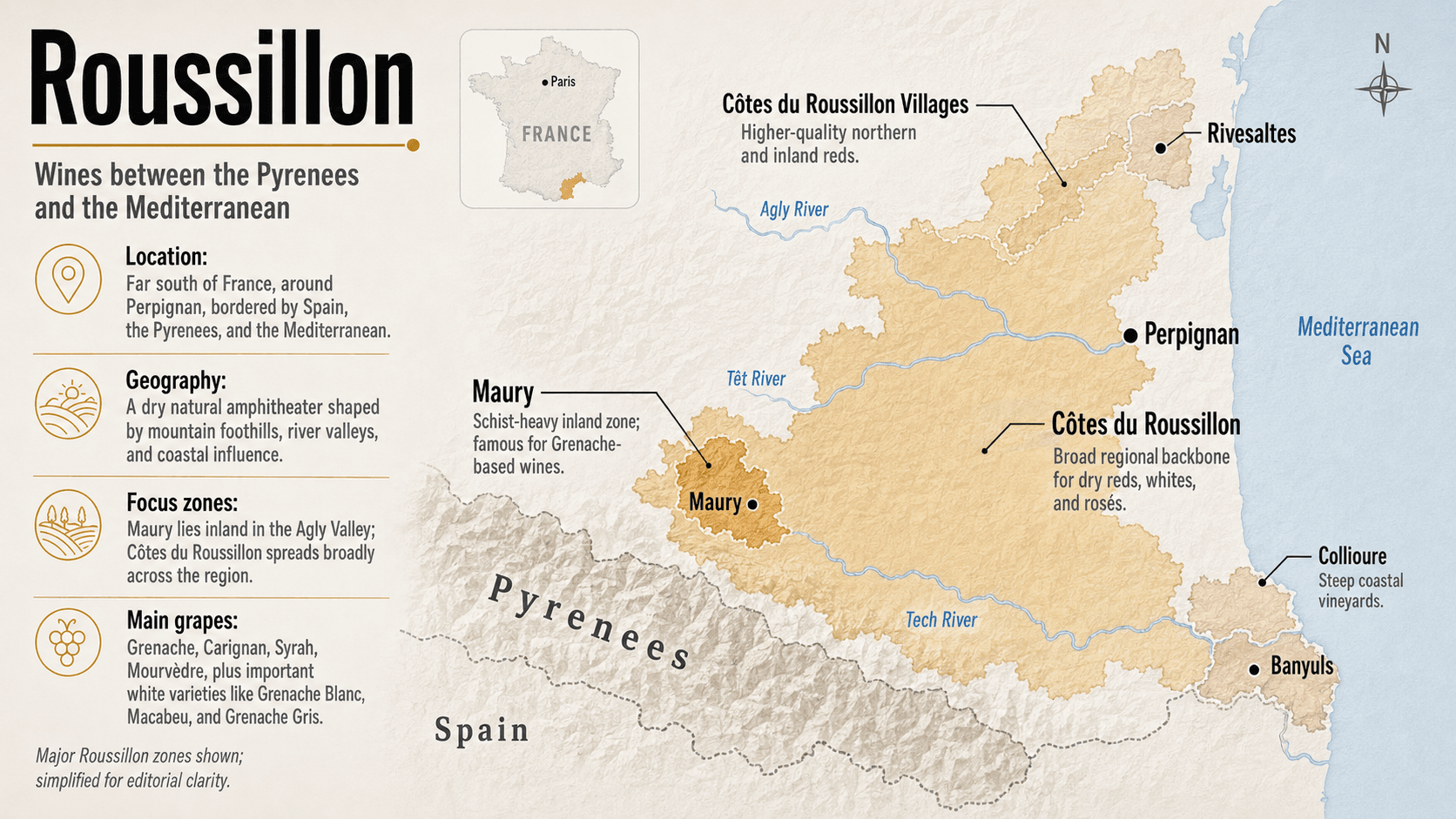 Here is a look at the Roussillon region, which lies right up against the Spanish border.
 Roussillon, formerly grouped with Languedoc administratively but now recognized as a distinct viticultural region, occupies the Catalan-influenced corner along the Spanish border. Its signature wines are the Vins Doux Naturels, fortified sweet wines including the renowned Banyuls and Maury, produced primarily from Grenache. Roussillon also yields compelling dry reds under the Côtes du Roussillon, Côtes du Roussillon Villages, and Collioure appellations, often from vines rooted in schist and granite soils that lend the wines a distinctive mineral intensity.
France is home to over 360 officially recognized AOC wine regions, ranging from globally famous areas like Bordeaux and Burgundy to smaller appellations producing highly distinctive regional wines.
Corsican wine reflects the island’s dramatic mix of mountains, coastline, granite soils, intense sunlight, and cooling maritime winds. A wide array of grapes such as Niellucciu, Sciaccarellu, and Vermentinu give the wines a distinctive identity, producing savory reds, fragrant rosés, and fresh, mineral whites.
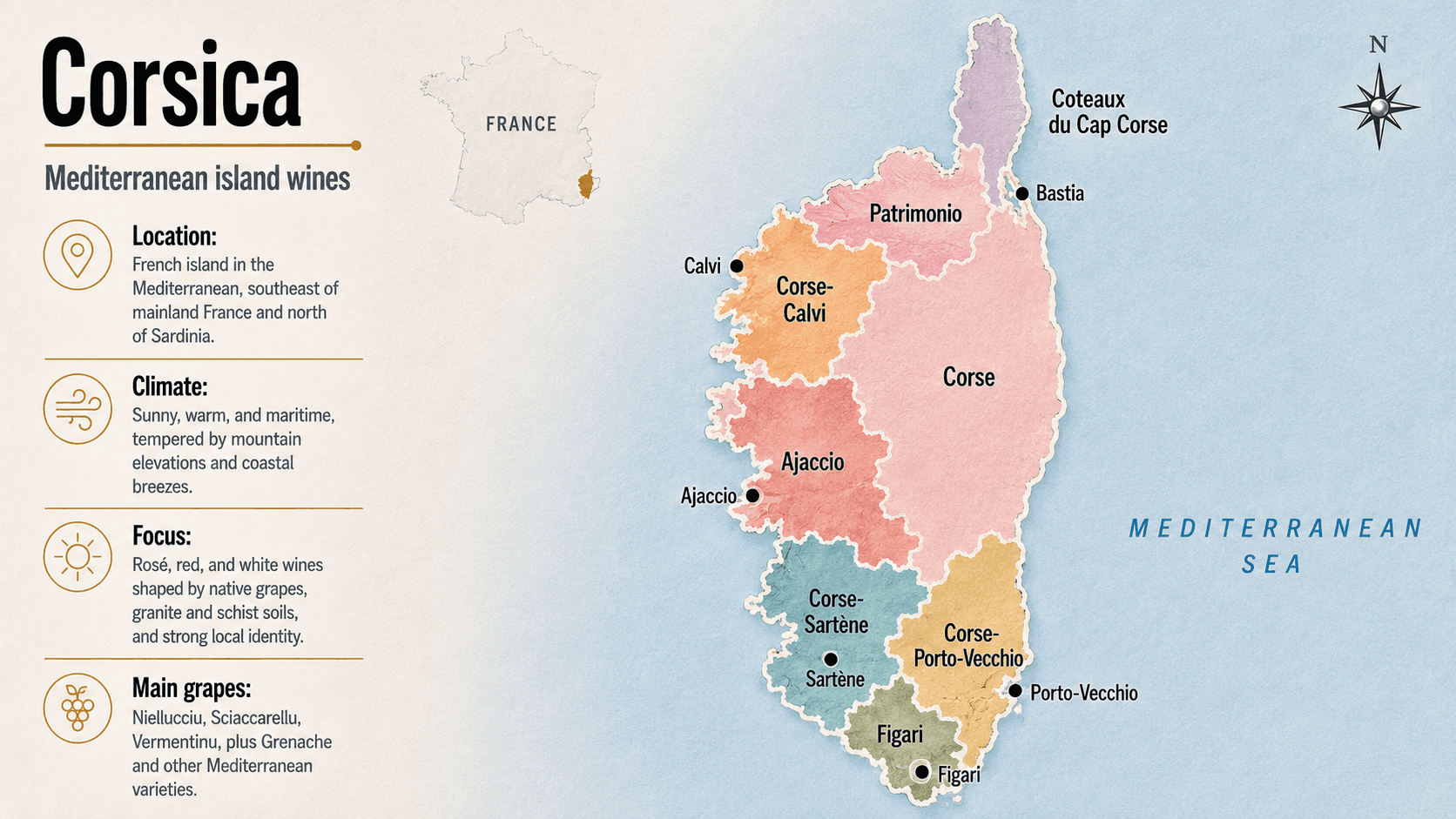
The island’s key appellations include Patrimonio, Ajaccio, and Vin de Corse, each shaped by different elevations, soils, and coastal influences. Corsica stands out for wines that combine Mediterranean ripeness with herbal complexity, bright acidity, and a strong sense of place.
France produced approximately 3.7 billion liters of wine in 2024, its lowest output in decades and a 23.5% decline from 2023, battered by frost, drought, mildew, and the deliberate removal of tens of thousands of hectares of uneconomic vineyards. Domestic consumption continues its generational decline, and younger French consumers are drinking less wine than any generation before them. The challenges are real and structural. Yet France's position at the summit of global wine culture remains secure, not because of volume, but because of depth. No other country offers the same combination of regional diversity, classification rigor, historical continuity, and sheer quality across every style of wine imaginable.
From a seven-dollar Côtes du Rhône to a seven-thousand-dollar bottle of Romanée-Conti, from the chalk cellars of Champagne to the sun-baked garrigue of Châteauneuf-du-Pape, France provides the framework through which the rest of the wine world makes sense. For the beginning wine lover, learning France is not about memorizing appellations or classification hierarchies. It is about understanding that place, climate, soil, and centuries of human attention can converge in a glass to create something irreplaceable.
France helped define modern wine culture through its appellation system, historic regions, and the global spread of French grape varieties and winemaking traditions.
Some of the most influential regions include Bordeaux, Burgundy, Champagne, the Loire Valley, Rhône Valley, Alsace, Provence, and Languedoc-Roussillon.
Cabernet Sauvignon, Merlot, Chardonnay, Pinot Noir, Sauvignon Blanc, Syrah, and Chenin Blanc are among the most widely planted and internationally influential French grape varieties.
Terroir refers to the combined influence of soil, climate, elevation, and local traditions that shape how grapes grow and ultimately how the wine tastes.
French labeling traditionally emphasizes place rather than varietal, reflecting the belief that the region and terroir define the character of the wine more than the grape itself.

A shared rulebook, eight sets of grapes, and a price that still undercuts the neighbor to the north. The category rewards anyone willing to read past the word on the label.

Exploring the regional identities that make the Loire one of France’s most varied wine-producing areas.

The Appellation d'Origine Contrôlée is the most imitated idea in wine, the reason a French label names a place instead of a grape. It guarantees a great deal, but not quite the thing most people assume.

On a sunlit ribbon of vineyards between the Vosges mountains and the Rhine, France makes some of its most distinctive and age-worthy whites. To understand them is to understand a borderland that has belonged to two nations and kept the best of both.

Tucked between the Pyrenees and the Mediterranean, a wine region with one foot in Spain has quietly preserved what other places forgot. Its old vines and Catalan soul make it one of the most compelling unfinished stories in the wine world.

In a matter of weeks, a group of Bordeaux wine brokers created the most famous hierarchy in wine history. More than 170 years later, it remains the standard against which all other classifications are measured.

Where monastic devotion to single vineyards created a wine philosophy that transforms Pinot Noir and Chardonnay into liquid poetry, commanding prices that defy economic logic.

The southern Rhône's most storied appellation did not become great by accident. It was shaped by papal ambition, ancient soils, and a fierce commitment to protecting what the land could produce.

Corsica produces some of the most distinctive and least understood wines in France, shaped by a history as rugged and independent as the island's own landscape.

Tucked between Burgundy and the Swiss Alps, a narrow strip of vineyard land produces some of the most unusual and compelling wines in the world.

From chalky soils to celebratory toasts, understanding the world's most revered sparkling wine begins with knowing its origins.

Exploring the legendary French wine appellation where terroir, history, and aristocratic ambition converge in every bottle.

Where devotion to terroir and uncompromising quality standards create bottles that transcend wine to become cultural artifacts commanding unprecedented devotion and prices.

Two grapes that define Mediterranean winemaking, creating everything from powerful single-variety statements to harmonious blends that capture the essence of southern French viticulture.

Where centuries of tradition meet modern innovation, creating wines that define luxury and establish benchmarks for producers worldwide.