A Conversation about Barolo and Barbaresco
Two of Italy's greatest wines share a grape, a region, and a philosophical commitment to place. Understanding them together reveals more than comparing them ever could.
Exploring the Regions, Grapes, and Traditions Behind One of the World’s Most Diverse Wine Cultures

Italy is the oldest, largest, and most bewilderingly diverse wine-producing nation on earth. Vines have been cultivated on the Italian peninsula for over 3,000 years. Every one of the country's 20 administrative regions produces wine. Over 500 native grape varieties are commercially cultivated, many of them found nowhere else in the world, and Italy's classification system encompasses more than 400 DOC and DOCG designations. In 2024, Italy reclaimed its position as the world's leading wine producer with 44 million hectoliters, surpassing both France and Spain. Its exports reached a record EUR 8.1 billion, making Italy the top global wine exporter by volume and second only to France by value. The country's 728,000 hectares of vineyard, 241,000 agricultural companies, and 30,000 winemaking operations represent approximately 10% of the entire national agri-food sector.
Wine tourism drew 15 million visitors in 2024, generating nearly EUR 3 billion. Yet for all this scale, Italy remains a nation of small producers. Thirty-five percent of Italian grape growers work plots of fewer than five hectares. The result is a wine culture of extraordinary depth and fragmentation, where the difference between one hillside and the next can mean the difference between a EUR 10 everyday red and a EUR 500 collectible. For the new wine lover, Italy can feel overwhelming. The key is to start with the major regions, understand the core grapes, and let the rest unfold over time.
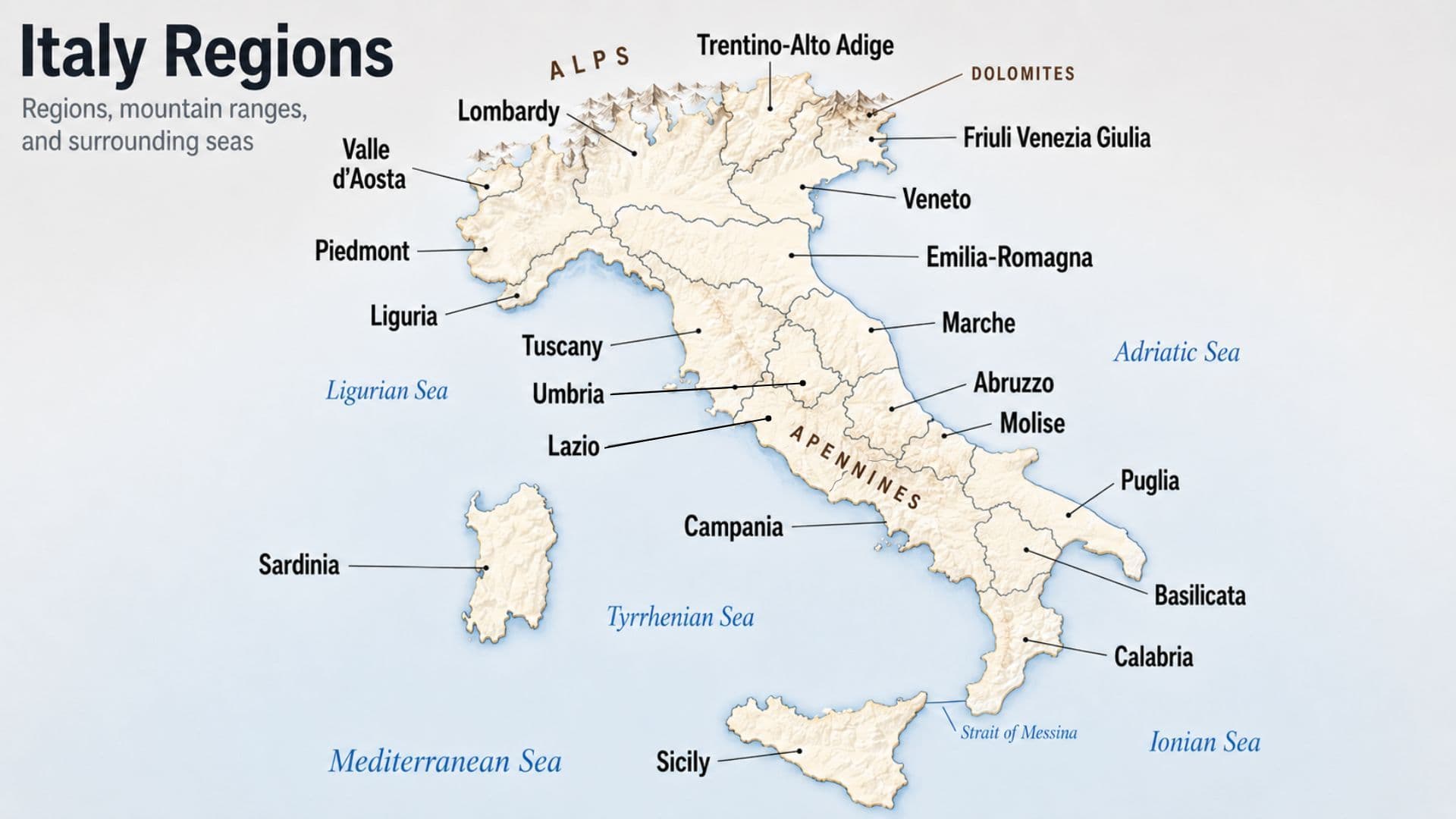
Nearly every region in Italy produces wine, from the Alpine vineyards of the north to the volcanic soils of Sicily and Campania.
The ancient Greeks called the Italian peninsula Oenotria, the land of wine, when they established colonies in the south around the eighth century BC. The Etruscans, who preceded the Romans in central Italy, were accomplished viticulturists whose techniques influenced winemaking throughout the peninsula. Under Rome, wine production expanded dramatically, becoming both an economic engine and a cultural institution. Roman writers including Pliny the Elder cataloged grape varieties, vineyard practices, and regional reputations with a precision that would not be matched again for over a millennium.
After the fall of Rome, the Catholic Church sustained viticultural knowledge through the Middle Ages, just as it did in France. Monasteries maintained vineyards across the peninsula, and the noble families of regions like Tuscany and Piedmont cultivated wine as both agricultural product and status symbol. Italy's political fragmentation, however, which persisted until unification in 1861, meant that wine traditions developed independently in dozens of distinct cultural zones. This is why Italy has so many indigenous grape varieties. Each region, each valley, each hilltop village nurtured its own vines for centuries with little outside influence.
The modern Italian wine industry took shape in the mid-20th century, catalyzed by the creation of the DOC (Denominazione di Origine Controllata) system in 1963 and the higher-tier DOCG (Denominazione di Origine Controllata e Garantita) in 1980. These designations regulate grape varieties, yields, aging requirements, and geographic boundaries. Below them sits the IGT (Indicazione Geografica Tipica) category, created in 1992 largely in response to the Super Tuscan movement, which gives winemakers greater creative freedom while still indicating geographic origin.
Piedmont, in the northwest corner of Italy where the foothills meet the Alps, produces the country's most regal and age-worthy red wines. The region is home to 19 DOCG designations, the highest count in Italy, with over 94% of its wine carrying a protected origin designation. The landscape of the Langhe hills, designated a UNESCO World Heritage Site, is the spiritual center of Piedmontese winemaking, and the Nebbiolo grape is its undisputed king.
Nebbiolo, named for the nebbia (fog) that blankets the Langhe during autumn harvest, is one of the most demanding grapes in viticulture. It buds early, ripens late, requires specific limestone and clay soils, and rarely succeeds outside a handful of zones in northwestern Italy. Yet when it finds the right conditions, it produces wines of extraordinary complexity: pale garnet in color but massive in structure, with haunting aromatics of roses, tar, dried cherry, truffle, and leather that evolve over decades of cellaring.
Barolo is made from 100% Nebbiolo grown across 11 communes southwest of the town of Alba. The wine must age a minimum of 38 months (18 in oak), and Riserva bottlings require 62 months. Five communes dominate production: Barolo, Castiglione Falletto, La Morra, Monforte d'Alba, and Serralunga d'Alba, each producing distinct expressions based on soil composition, elevation, and exposure. Wines from La Morra tend to be perfumed and silky; those from Serralunga are more austere, tannic, and built for long aging. The region produces approximately 500,000 cases annually.
Before the 19th century, Barolo was actually a sweet wine, because cold Piedmontese cellars would halt fermentation before all the sugar was consumed. The transformation into a structured, dry red is credited to Camillo Benso, Count of Cavour, the statesman who would later help unify Italy. In the 1840s, Cavour hired French winemaker Louis Oudart, who heated the fermentation rooms to allow complete fermentation and introduced modern cellar management. The result was the powerful, dry Barolo we recognize today. In the 1980s, a group of young winemakers known as the Barolo Boys pushed further, introducing small French oak barriques and shorter maceration times to create more approachable, fruit-forward wines. The philosophical tension between these traditionalists and modernists continues to shape the region.
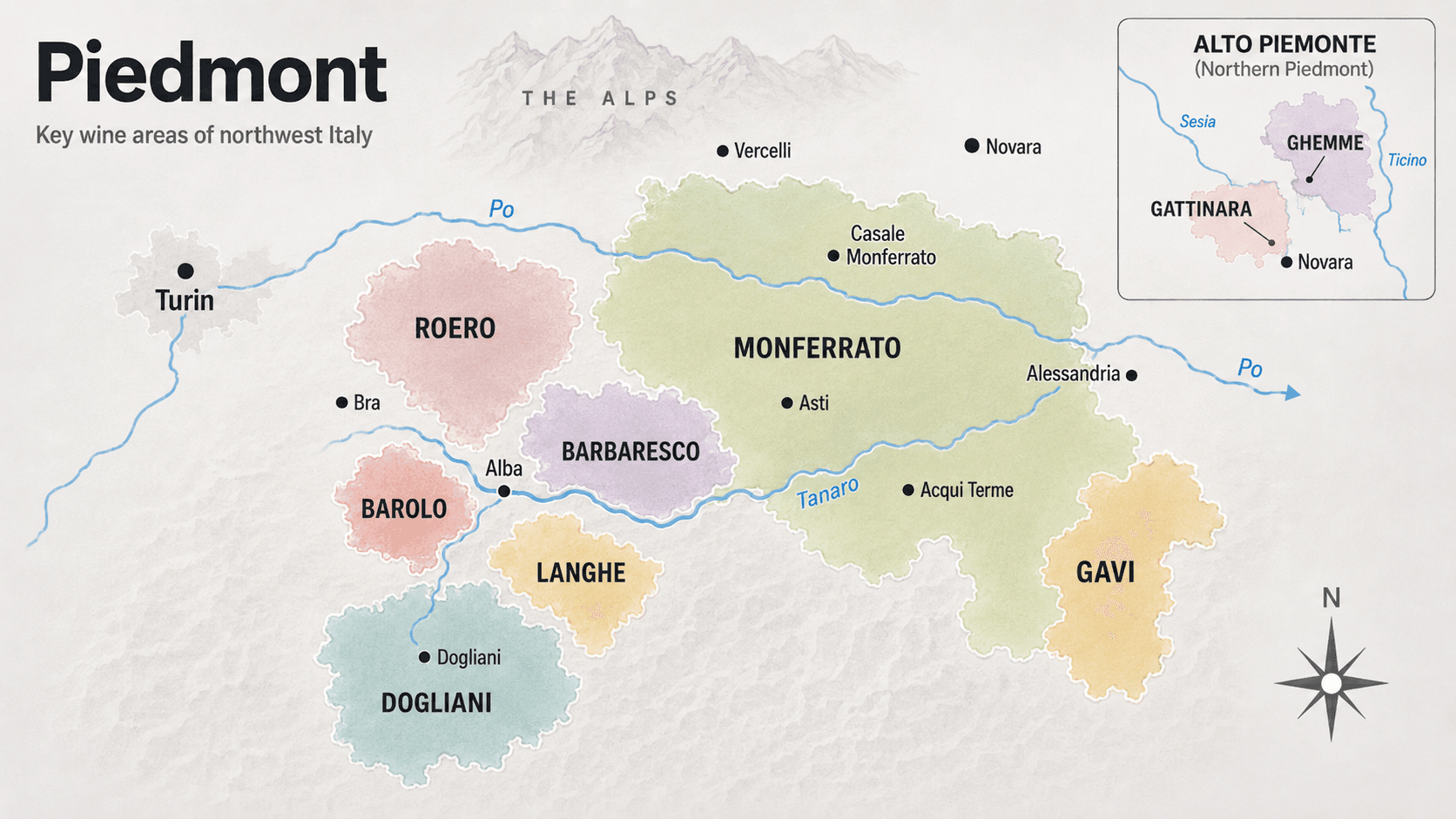
Barbaresco, Barolo's neighboring DOCG, is very similar in style and price point. Also made from 100% Nebbiolo, it comes from three main communes (Barbaresco, Neive, and Treiso) and requires shorter minimum aging of 26 months. Barbaresco tends to be more elegant, floral, and approachable in youth than Barolo, though the finest examples age magnificently. The appellation's modern identity was shaped by Angelo Gaja, whose single-vineyard bottlings beginning in the 1960s placed Barbaresco on the global fine wine map.
Piedmont is far more than Nebbiolo, however. Barbera, the most widely planted grape in the region, produces juicy, high-acid reds with dark fruit character, particularly from the Asti and Alba zones. Dolcetto yields soft, everyday drinking wines. Moscato d'Asti, a gently sparkling, low-alcohol sweet wine, is one of Italy's most delightful and underappreciated styles. Arneis and Cortese (the grape behind Gavi) provide crisp, mineral whites.
If Piedmont is Italy's aristocratic north, Tuscany is its passionate heart. Located in central Italy between Florence and Siena, Tuscany's rolling hills, cypress-lined roads, and medieval villages form perhaps the most iconic wine landscape in the world. The region holds 11 DOCG and 41 DOC designations, and its signature grape, Sangiovese, occupies more than 100,000 hectares across Italy, with Tuscany as its undisputed homeland.
Chianti is the region's most famous and historically important wine. The Chianti Classico zone, the original growing area between Florence and Siena first legally designated in 1716, produces the finest expressions: medium to full-bodied reds based on Sangiovese with bright cherry fruit, firm acidity, earthy tannins, and a savory character that makes them natural partners for Italian cuisine. The appellation underwent a dramatic quality revolution beginning in the late 1970s, after decades of overproduction and declining reputation had reduced Chianti to a commodity associated with straw-wrapped fiasco bottles. New production rules raised minimum Sangiovese requirements, eliminated the mandatory inclusion of white grapes, and imposed stricter yield limits. In 2014, the Gran Selezione tier was introduced as the apex of the Chianti Classico pyramid, requiring a minimum 30 months of aging and production exclusively from estate-grown grapes.
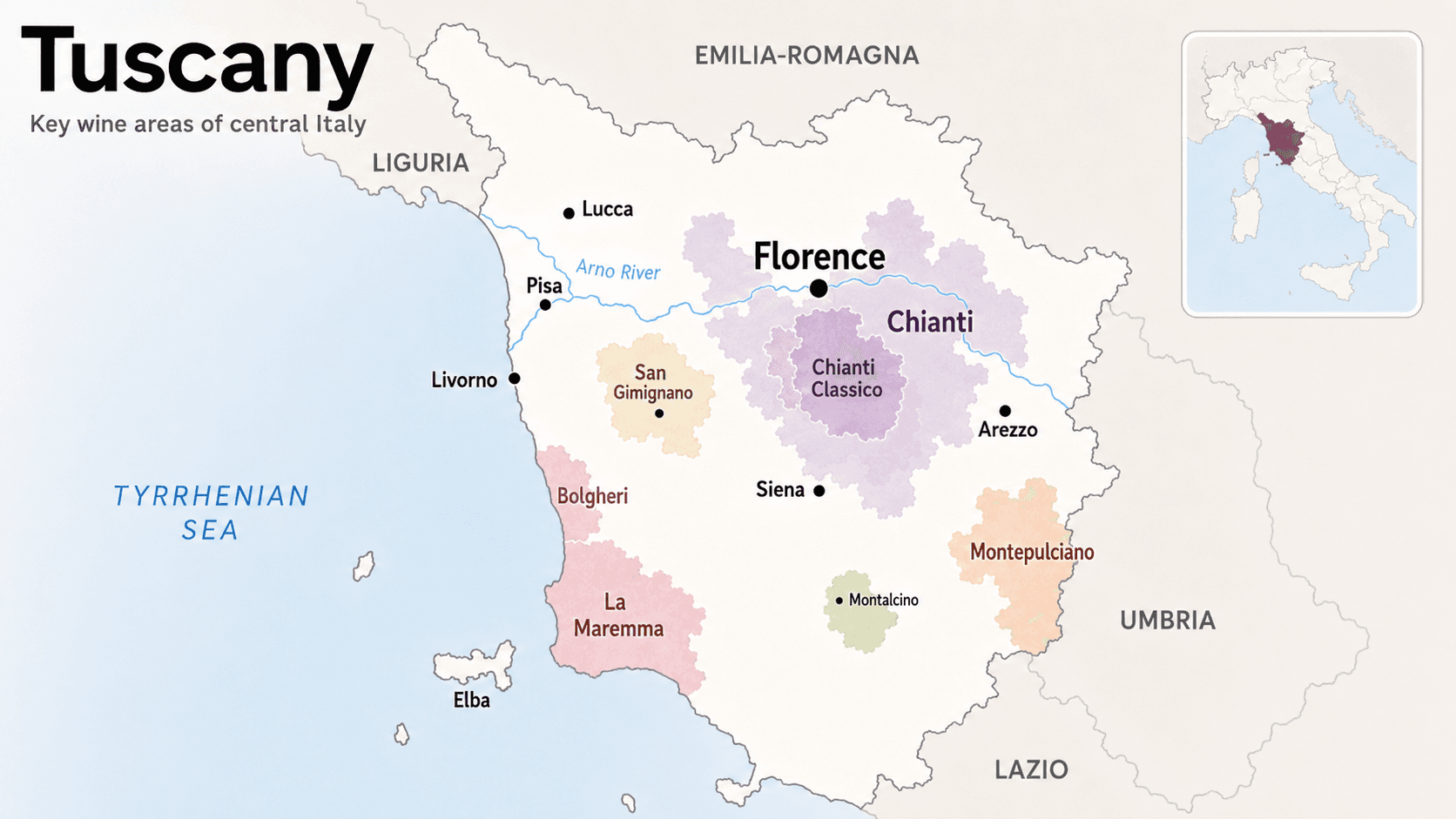
Brunello di Montalcino, produced south of the Chianti Classico zone in the warmer, drier hills around the town of Montalcino, is one of Italy's most prestigious and age-worthy wines. Made entirely from the Brunello clone of Sangiovese, it must age a minimum of four years before release (five for Riserva), including at least two years in oak. The wine was pioneered in the mid-19th century by Clemente Santi, who isolated the Brunello clone, and popularized by his grandson Ferruccio Biondi-Santi in subsequent decades. Brunello became the first Italian wine to receive DOCG status in the 1980s. Today, approximately 250 producers craft around 333,000 cases annually of intensely colored, full-bodied wine with flavors of dark cherry, tobacco, leather, and earth that can age gracefully for 30, 40, even 50 years in exceptional vintages. Rosso di Montalcino, sometimes called "Baby Brunello," offers a more affordable, earlier-drinking alternative from the same vineyards.
Tuscany also gave birth to the Super Tuscan movement, one of the most consequential developments in modern Italian wine. In the late 1960s and 1970s, frustrated by what they viewed as restrictive DOC regulations that prioritized tradition over quality, a handful of visionary producers began blending international grape varieties like Cabernet Sauvignon and Merlot with, or sometimes instead of, Sangiovese. The resulting wines were deliberately declassified to the lowest tier (Vino da Tavola) because they did not conform to existing rules. Marchese Mario Incisa della Rocchetta created Sassicaia, a Bordeaux-style Cabernet from the coastal town of Bolgheri, for personal consumption before releasing it commercially in 1968. Piero Antinori followed in 1971 with Tignanello, blending Sangiovese with Cabernet Sauvignon and aging in French barriques. These wines were hailed by international critics, commanded premium prices despite their humble legal classification, and forced a reckoning with Italy's regulatory system. The creation of the IGT designation in 1992 finally gave these wines an appropriate home, and Bolgheri received its own DOC, but the spirit of creative rebellion that Super Tuscans embody remains central to Tuscany's identity.
The Veneto, in Italy's northeast, is the country's most prolific wine-producing region by volume and the engine behind Italy's sparkling wine boom. Prosecco, made from the Glera grape primarily in the hills between Conegliano and Valdobbiadene, has become one of the most commercially successful wines on the planet. Prosecco DOC exports surged 15% in volume and 11% in value in 2024, reaching EUR 1.82 billion and accounting for over 75% of Italy's total sparkling wine exports. Unlike Champagne, Prosecco undergoes its secondary fermentation in pressurized tanks (the Charmat method) rather than in bottle, producing a fresh, fruit-forward, approachable style designed for immediate enjoyment.
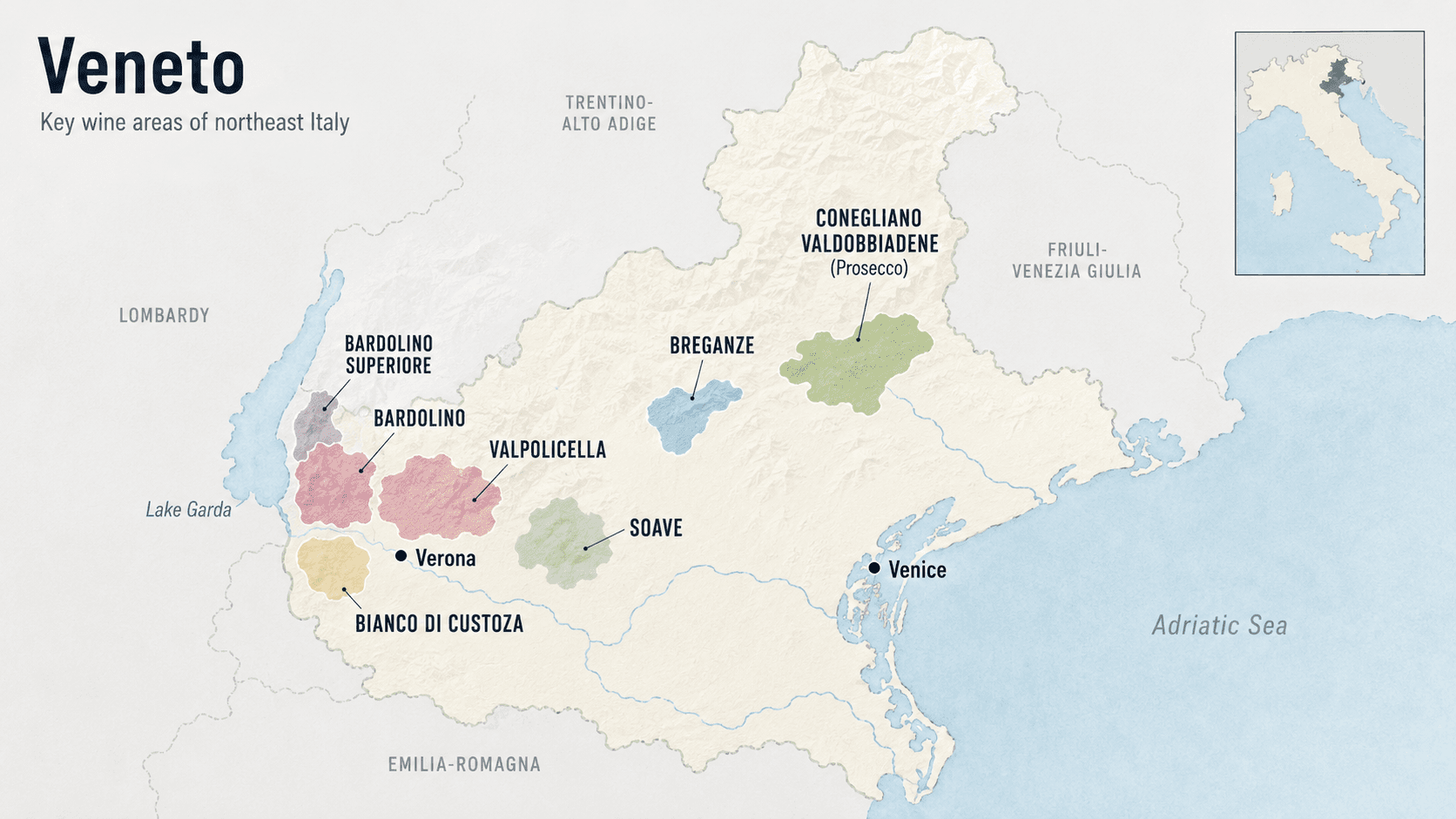
Beyond Prosecco, the Veneto produces two of Italy's most distinctive red wines. Amarone della Valpolicella, made from partially dried (appassimento) Corvina, Rondinella, and Molinara grapes, is a rich, powerful, high-alcohol wine with flavors of raisin, dark chocolate, fig, and dried cherry. The drying process, which concentrates sugars and flavors over several months, produces wines of extraordinary density and complexity. Valpolicella Ripasso, sometimes called "baby Amarone," gains additional richness by being refermented on the spent grape skins from Amarone production.
The Veneto also produces enormous volumes of Pinot Grigio and Soave (from the Garganega grape), both of which can range from simple and commercial to genuinely characterful depending on the producer and the specific vineyard site.
Marche spans the central Adriatic between the Apennines and the sea, producing more white than red. Its five DOCGs are Castelli di Jesi Verdicchio Riserva and Verdicchio di Matelica Riserva (both 2010), Cònero and Vernaccia di Serrapetrona (both 2004), and Offida. Verdicchio is the flagship white: the maritime Castelli di Jesi DOC drinks earlier, while high, landlocked Matelica is firmer and age-worthy. The reds rest on Montepulciano, seen in Rosso Cònero and its Cònero DOCG, and in the Montepulciano-Sangiovese Rosso Piceno DOC. Note the oddities: the floral Lacrima di Morro d'Alba DOC and the red sparkling Vernaccia di Serrapetrona, from Vernaccia Nera.
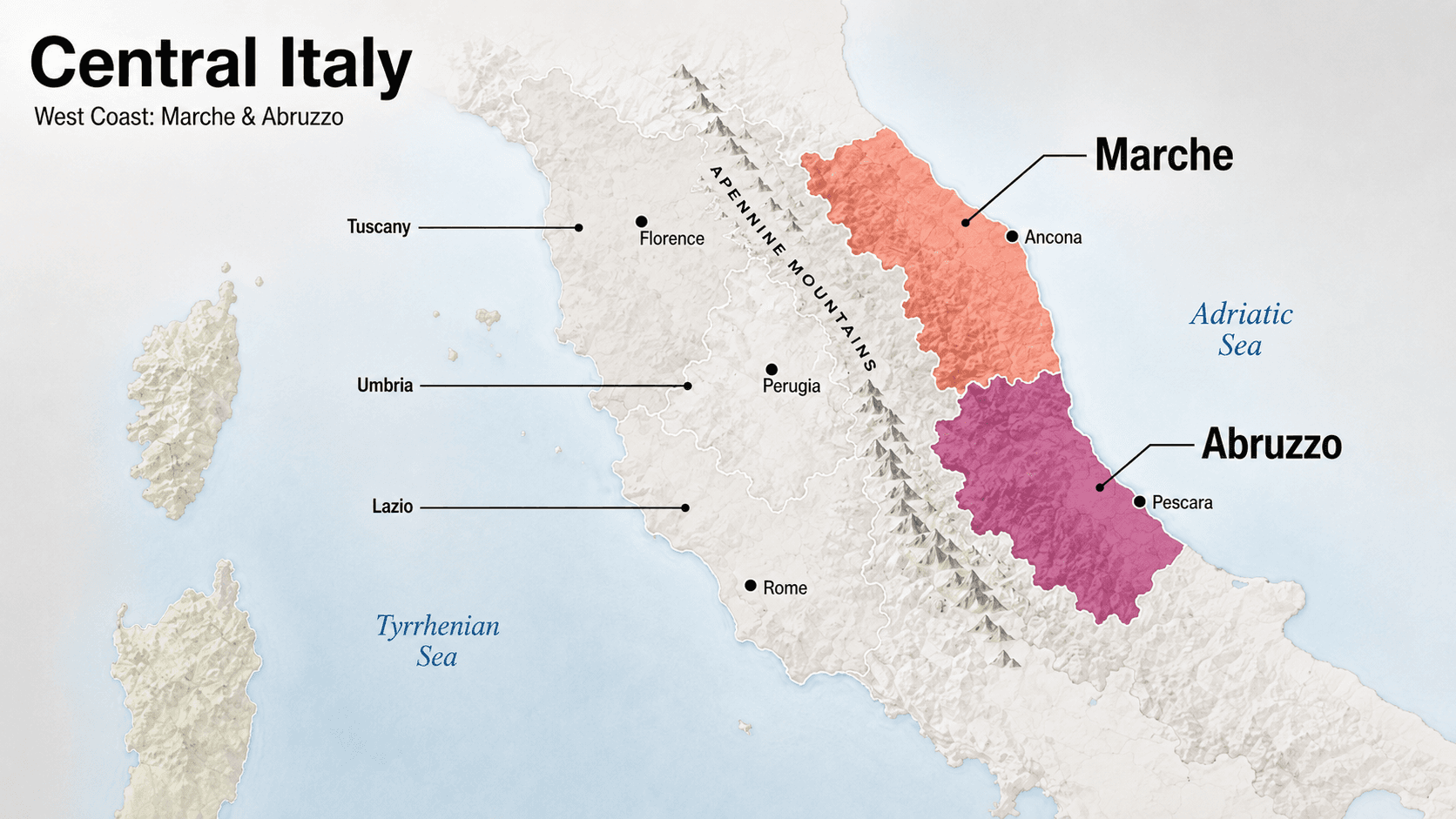
Abruzzo runs from the Gran Sasso massif down to the Adriatic and ranks among Italy's most productive regions. Its red backbone is Montepulciano, unrelated to the Tuscan town behind Vino Nobile; Montepulciano d'Abruzzo DOC exceeds half of all plantings, while Cerasuolo d'Abruzzo DOC (2010) is its cherry-hued rosato. Trebbiano d'Abruzzo, best from the native Trebbiano Abruzzese, reaches its summit under Valentini and Emidio Pepe. Under the recent Abruzzo Model, the regional DOCs added provincial menzioni geografiche and eight IGPs became one, Terre Abruzzesi. The DOCGs now number three: Colline Teramane (2003), Tullum, or Terre Tollesi (2019), and Casauria (2025).
Southern Italy, long dismissed as a source of anonymous bulk wine, is experiencing a genuine renaissance driven by the rediscovery of ancient indigenous grape varieties and a new generation of quality-focused producers. Campania, the region surrounding Naples, is the epicenter of this revival.
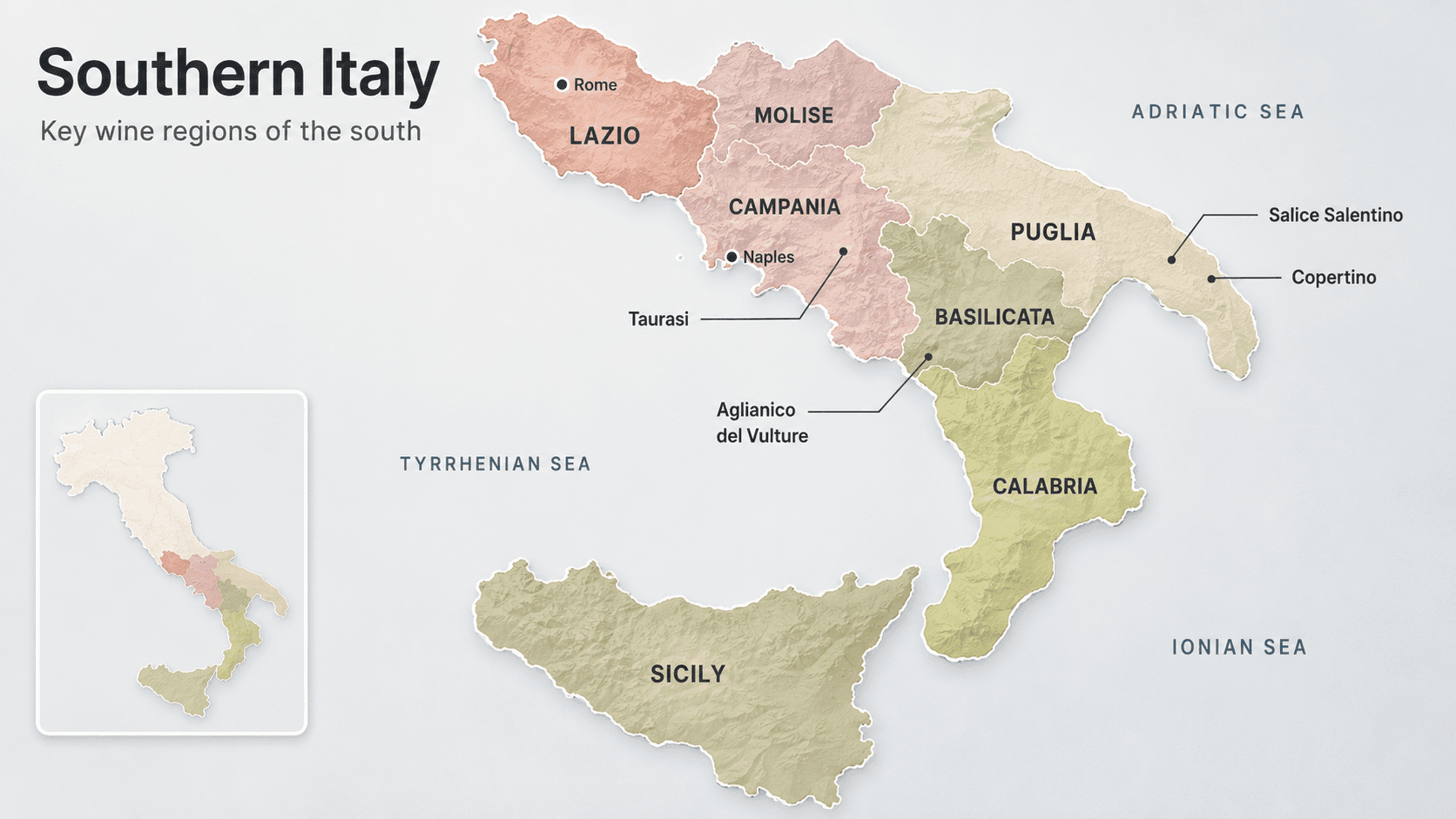
Aglianico, often called the Barolo of the South, produces wines of formidable structure, deep color, and impressive aging potential from the volcanic soils of Taurasi DOCG in the hills of Irpinia and from the Aglianico del Vulture DOC in neighboring Basilicata. The grape arrived with Greek colonists and has been cultivated continuously for over 2,500 years. Fiano di Avellino and Greco di Tufo, both DOCG white wines from Campania, rank among Italy's finest whites: Fiano is rich, honeyed, and mineral; Greco is structured, citrus-driven, and remarkably age-worthy.
Puglia, the heel of Italy's boot, is the country's largest wine-producing region by volume and the source of dense, fruit-driven reds from Primitivo (genetically identical to California's Zinfandel) and Negroamaro. Calabria, Sardinia, and Basilicata round out a southern portfolio that offers some of the best values in Italian wine.
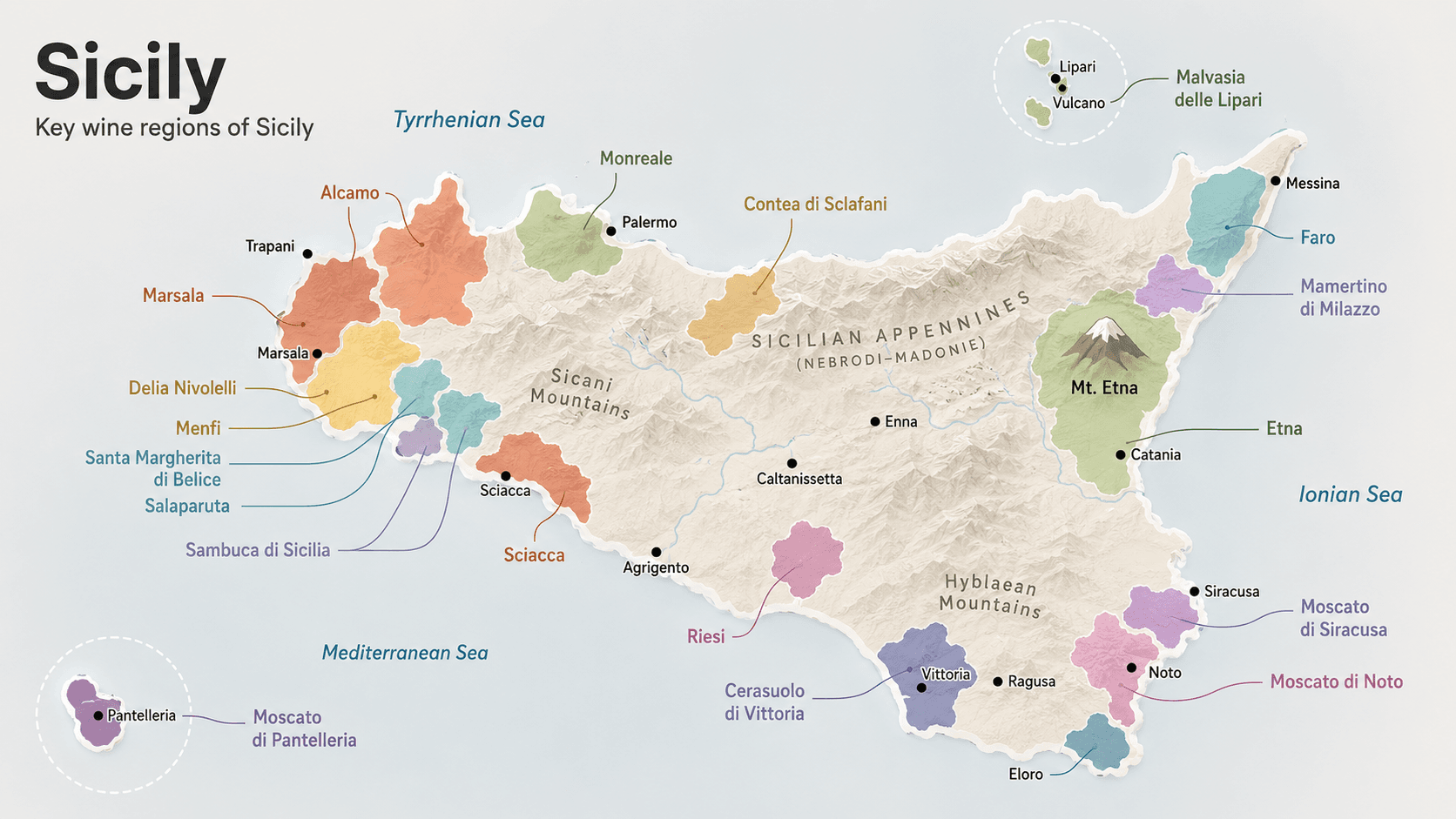
Sicily, the Mediterranean's largest island, deserves special attention as one of Italy's most dynamic wine regions. Volcanic soils from Mount Etna, the continent's most active volcano, have created a viticultural frontier that is attracting global interest and investment. Etna DOC wines, made primarily from the indigenous red grape Nerello Mascalese and the white Carricante, grown on the volcano's steep, terraced slopes at elevations reaching 1,000 meters, produce wines of startling elegance, minerality, and freshness that have drawn comparisons to Burgundy. The island also produces substantial volumes of Nero d'Avola, Sicily's most widely planted red grape, which yields warm, plush, dark-fruited wines, and a growing portfolio of whites from Grillo and Catarratto.
Italy produced 44 million hectoliters of wine in 2024, exported a record EUR 8.1 billion worth to 180 countries, and sustained a domestic culture in which 8.5 million people drink wine daily. Its 728,000 hectares of vineyard include 133,000 certified organic hectares, making Italy Europe's leader in organic viticulture. Yet the numbers only begin to describe the scope of what Italy offers. No other country can match its combination of sheer varietal diversity, regional distinctiveness, and historical continuity.
From the fog-shrouded Nebbiolo vineyards of the Langhe to the sun-blasted volcanic slopes of Mount Etna, from the structured, cerebral complexity of aged Barolo to the exuberant fizz of a fresh Prosecco, Italy provides an education in what wine can be when an entire civilization has spent three millennia perfecting it. The challenge for the beginner is not finding great Italian wine. It is deciding where to start. The answer, in the spirit of Italy itself, is simply to begin, drink with curiosity, and let each bottle lead you to the next.
Italy’s wine diversity comes from its geography, climate variation, and enormous number of native grape varieties. From the Alpine vineyards of the north to the warm Mediterranean islands of Sicily and Sardinia, each region produces wines that reflect unique local traditions and terroir.
Some of Italy’s most influential regions include Piedmont, Tuscany, Veneto, and Sicily, along with important areas such as Friuli Venezia Giulia, Trentino Alto Adige, and Campania. Each region specializes in different grape varieties and wine styles shaped by local climate and history.
Italy is known for grapes such as Sangiovese, Nebbiolo, Barbera, Montepulciano, and Corvina for red wines, along with white varieties like Pinot Grigio, Trebbiano, Garganega, and Verdicchio. Many of these grapes are indigenous to Italy and have been cultivated there for centuries.
DOC (Denominazione di Origine Controllata) and DOCG (Denominazione di Origine Controllata e Garantita) are classifications that regulate where wines are produced and how they are made. These designations ensure that wines meet specific standards related to grape varieties, yields, aging requirements, and regional authenticity.
Like much of Europe, Italian wine culture emphasizes geographic origin and traditional styles rather than varietal labeling. The name of a region, village, or appellation often indicates the grape varieties used and the style of wine produced there.

Two of Italy's greatest wines share a grape, a region, and a philosophical commitment to place. Understanding them together reveals more than comparing them ever could.

Italy's second largest island produces wines of fierce originality from ancient grape varieties that most of the world has yet to discover.

Where volcanic soils and indigenous grapes create wines of extraordinary character, proving that Italy's future may lie in rediscovering its deepest roots.

Where a single grape variety and hilltop terroir combine to create Italy's most prestigious and age-worthy red wines, commanding global reverence and premium prices.