Vines have grown on the Iberian Peninsula since the Phoenicians and Romans first pressed its fruit more than two thousand years ago, yet no country today devotes more land to the grape than Spain, where roughly 913,000 hectares of vineyard unfurl across high plateaus, river valleys, and sun-warmed coasts. For much of the twentieth century that vastness worked against the nation's reputation.
Spain is one of the world's most important wine-producing countries, yet it often receives less attention than France or Italy. Home to thousands of years of winemaking history, Spain combines ancient traditions with modern innovation across a diverse landscape of vineyards.
Spanish wine was prized for quantity, shipped in bulk, and too often dismissed as rustic. Entry into the European Community in 1986 and a generation of restless growers changed everything. Vintners returned to old bush vines and forgotten hillsides, traded fatigued barrels for precision, and began to speak the language of place.
Today, Spain offers one of the most rewarding terrains in all of wine, precisely because its diversity resists any single summary. To understand it, we travel from the Atlantic-cooled north to the baking center and down to the luminous south, where the very definition of wine bends toward something extraordinary.
Reading the Label: Spain's Quality Pyramid
Spanish wine law arranges itself as a pyramid, broad at the base and exacting at the summit. The foundation is Vino de España, simple wine without geographic claim. Above it sits Vino de la Tierra, the country's protected geographic indication, where some 43 zones may print grape and vintage under relaxed rules. The heart of the system is the Denominación de Origen, or DO, numbering 69 as of 2024, each policed by a Consejo Regulador that dictates permitted varieties, yields, and aging. Only two regions have ever reached the superior Denominación de Origen Calificada, abbreviated DOCa and rendered DOQ in Catalan: Rioja, elevated in 1991, and Priorat, recognized in 2009.
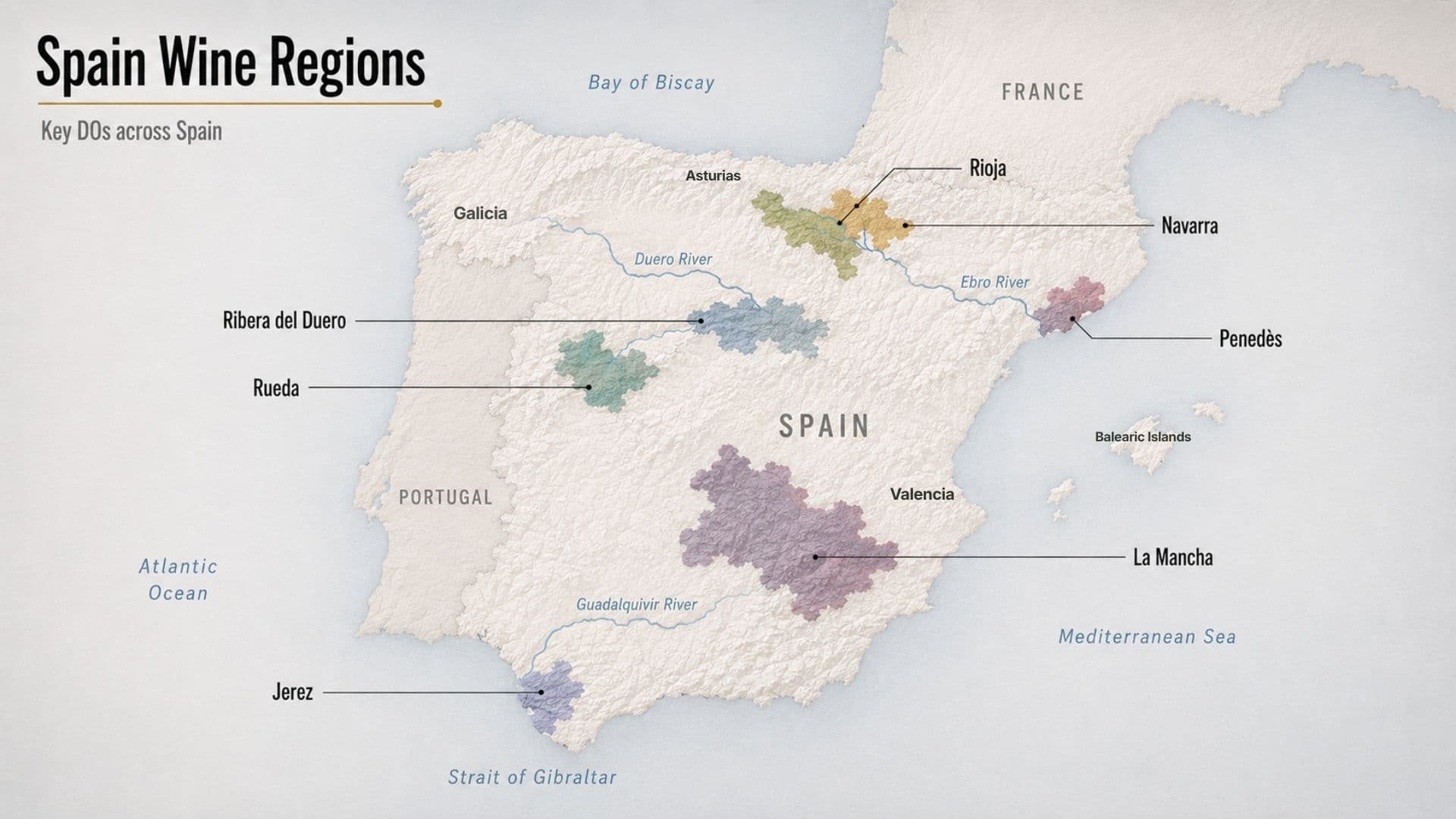
A separate single-estate tier, Vino de Pago, honors a handful of exceptional individual properties. Since 2016 these categories have been formally aligned with the European Union's protected-designation framework, though the traditional terms remain on labels. Just as telling are the aging words a buyer will see: Crianza wines rest roughly two years before release, Reserva about three, and Gran Reserva a stately five or more, each with stipulated minimums in cask. It is a uniquely Spanish generosity, selling wines already gentled by time.
Rioja: The Classic Standard-Bearer
If one region defines Spanish red wine in the popular imagination, it is Rioja, the nation's first DO in 1925 and first DOCa in 1991. Cradled by the Ebro River and sheltered by the Sierra de Cantabria, it divides into three zones, each with its own accent. Cooler, higher Rioja Alta and Rioja Alavesa, centered on the wine town of Haro, yield reds of elegance, fine minerality, and remarkable longevity, while warmer Rioja Oriental, formerly Rioja Baja, ripens fuller and rounder fruit. Tempranillo is the soul of the blend, traditionally joined by Garnacha, Graciano, and Mazuelo, with Viura anchoring the whites.
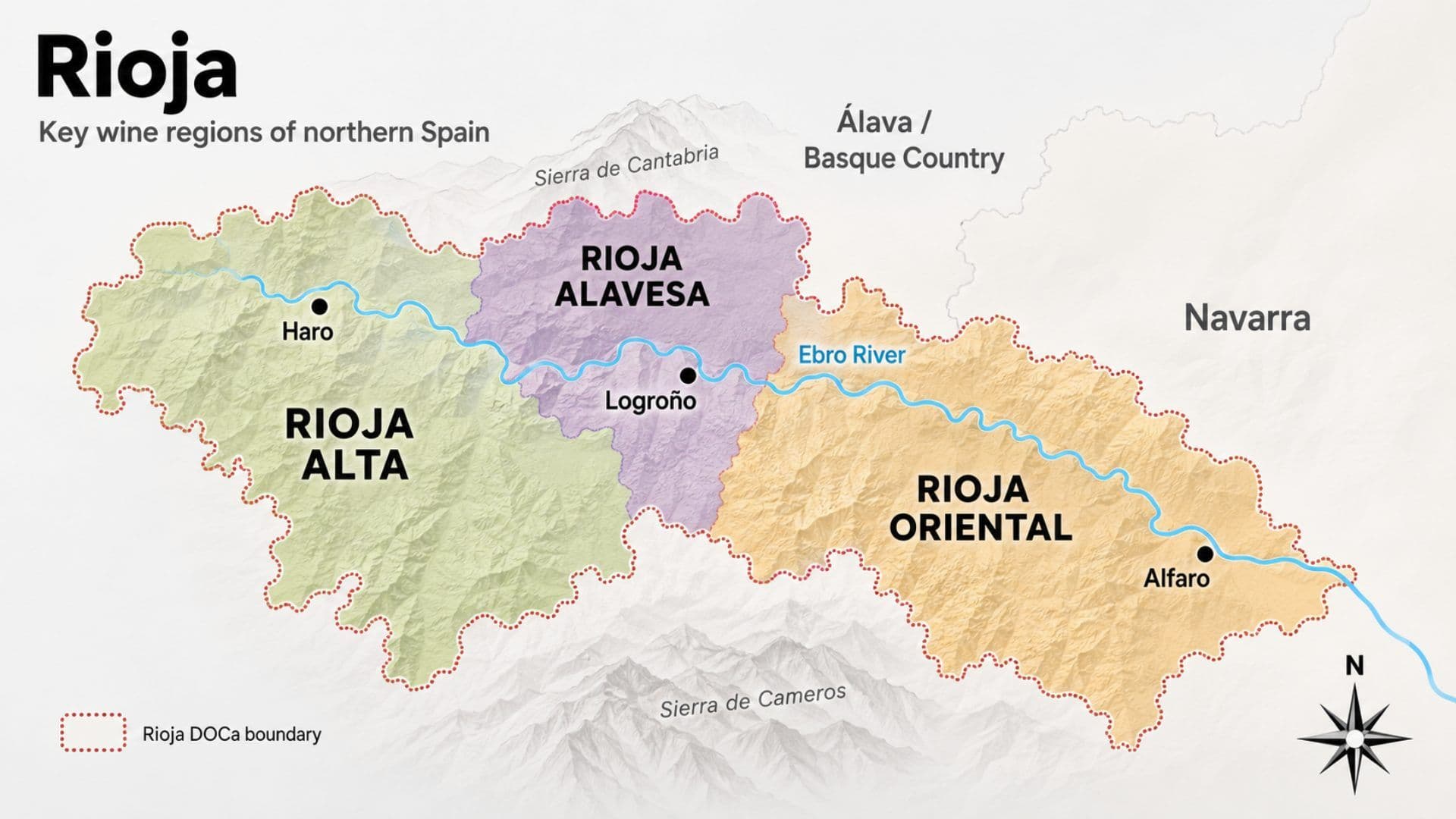
For generations Rioja's signature was a long sleep in American oak, lending coconut, vanilla, and sweet spice to its silky reds. Since the 2017 vintage a quiet revolution toward terroir has taken hold. Producers may now bottle by zone, by village under the Vino de Pueblo term adopted in 2024 across 144 towns, or from a single Viñedo Singular drawn from hand-harvested vines older than 35 years. Rioja, in short, is learning to name its addresses.
Ribera del Duero and Castilla y León
South and west of Rioja, the Duero River carves through the high tableland of Castilla y León, a continental landscape of scorching summers and frigid nights. Here Tempranillo wears local names, Tinto Fino and Tinta del País, and accounts for roughly 95 percent of plantings in its flagship appellation, yielding a darker, more muscular wine than its Riojan cousin. Ribera del Duero waited until 1982 for DO status despite a long history anchored by Bodegas Vega Sicilia, founded in 1864, whose Único remains Spain's most storied red, traditionally aged a decade or more before release.
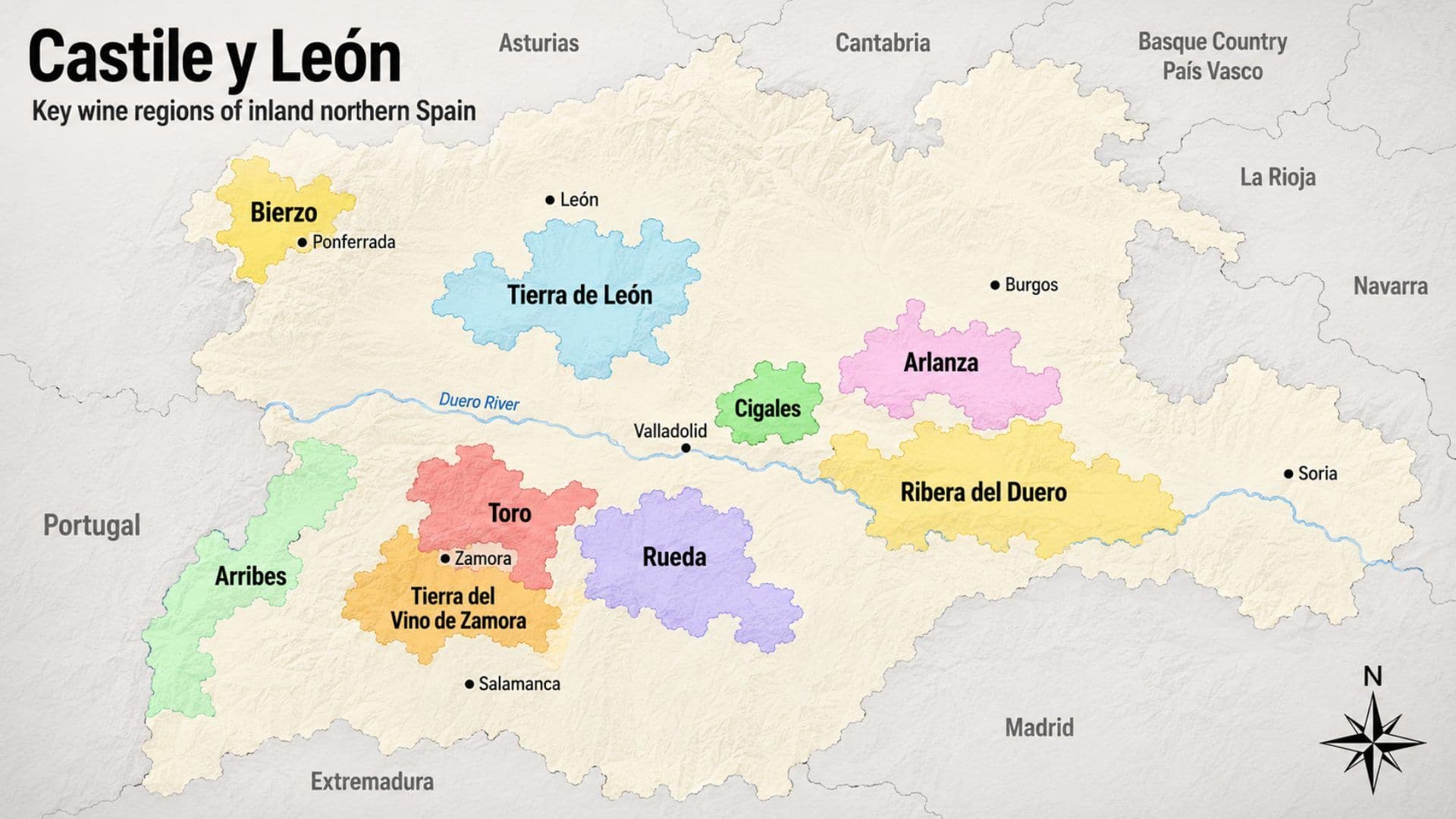
The arrival of Alejandro Fernández and his Pesquera in the 1980s, later joined by Dominio de Pingus and Emilio Moro, proved the plateau could rival anywhere on earth. Yet Castilla y León offers far more than Ribera. Downstream, Toro coaxes brawny, inky reds from a clone called Tinta de Toro; Rueda built its name on crisp, aromatic Verdejo whites; and Bierzo, to the northwest, channels the perfumed Mencía grape into something altogether lighter on its feet.
Galicia
Galicia is Spain’s cool, rainy northwestern wine region, where Atlantic winds, high humidity, and rugged coastal and river landscapes create some of the country’s freshest wines. Rías Baixas is its most famous appellation and the global home of Albariño, especially in the coastal Val do Salnés subzone, where granite soils and strong maritime influence encourage bright acidity and saline character. Albariño typically produces aromatic wines with citrus, peach, green apple, white flowers, and mineral notes, while lees aging can add texture, depth, and surprising longevity.
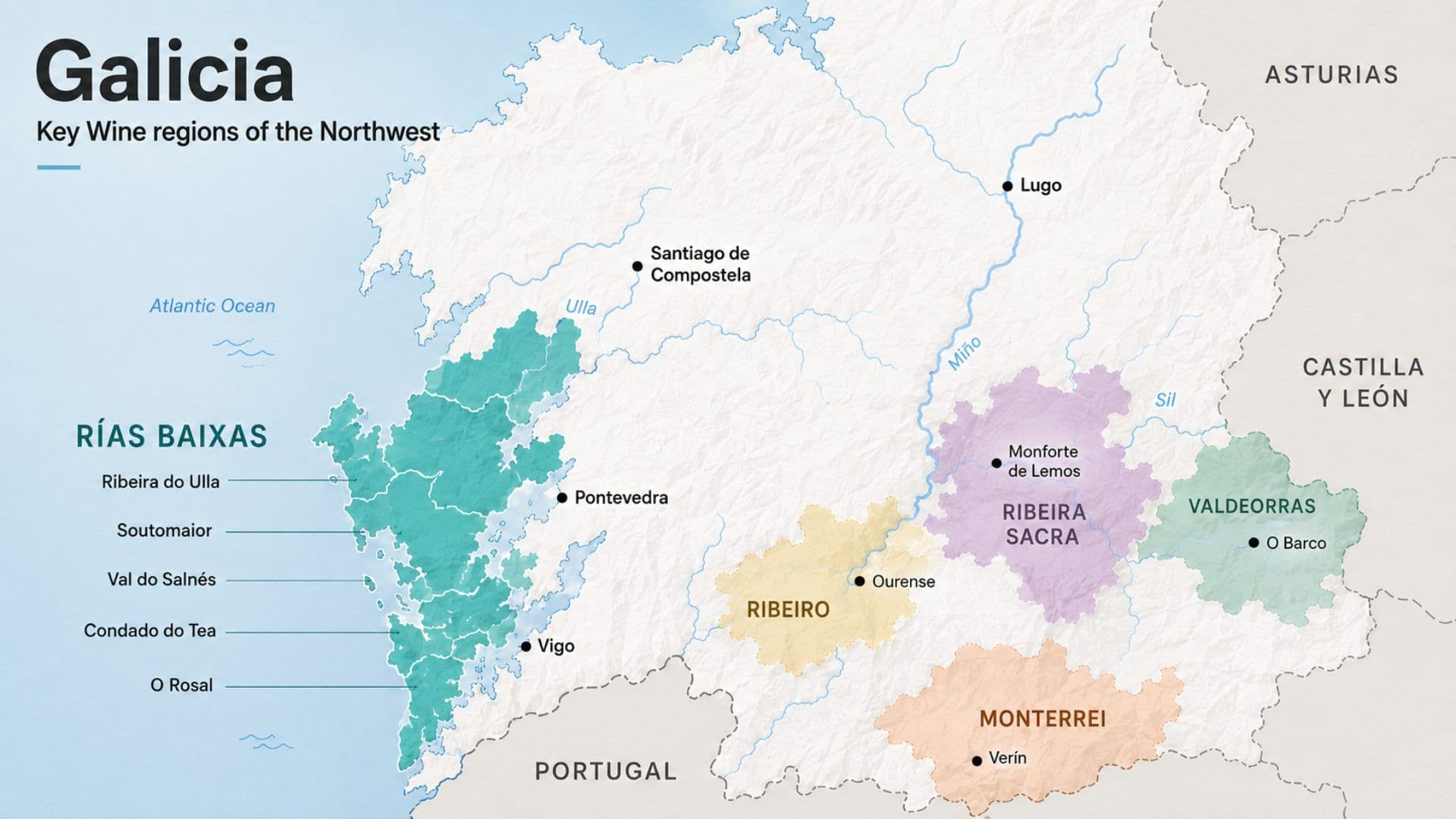
Beyond Rías Baixas, Galicia includes Ribeiro, Ribeira Sacra, Valdeorras, and Monterrei, regions that become progressively warmer and more continental as vineyards move inland. These areas expand the regional picture through grapes such as Godello, Treixadura, Mencía, and Loureiro, grown on soils ranging from granite to slate and clay. Together, they show that Galicia is not simply an Albariño region, but a diverse wine landscape united by freshness, difficult terrain, distinctive native grapes, and a strong connection to the Atlantic.
Catalonia
Catalonia is one of Spain's largest and most diverse wine regions, sweeping from the Pyrenees to the Mediterranean across roughly a dozen appellations, among them Penedès, Montsant, Empordà, Costers del Segre, and Terra Alta, all gathered beneath the umbrella DO Catalunya. Its crown jewel is Priorat, a rugged mountain enclave in Tarragona province where steep terraces (costers) and a fractured black slate soil known as llicorella force vines deep, producing dense, mineral reds from Garnacha and Cariñena. Near-abandoned by the 1980s, Priorat was reborn through René Barbier and the "Gang of Five," whose 1989 vintages made it a global benchmark. Today it is one of only two regions in Spain to hold the top DOCa/DOQ rank alongside Rioja, and its 2019 Els Noms de la Terra scheme adds a Burgundian ladder of village and single-vineyard tiers. land.
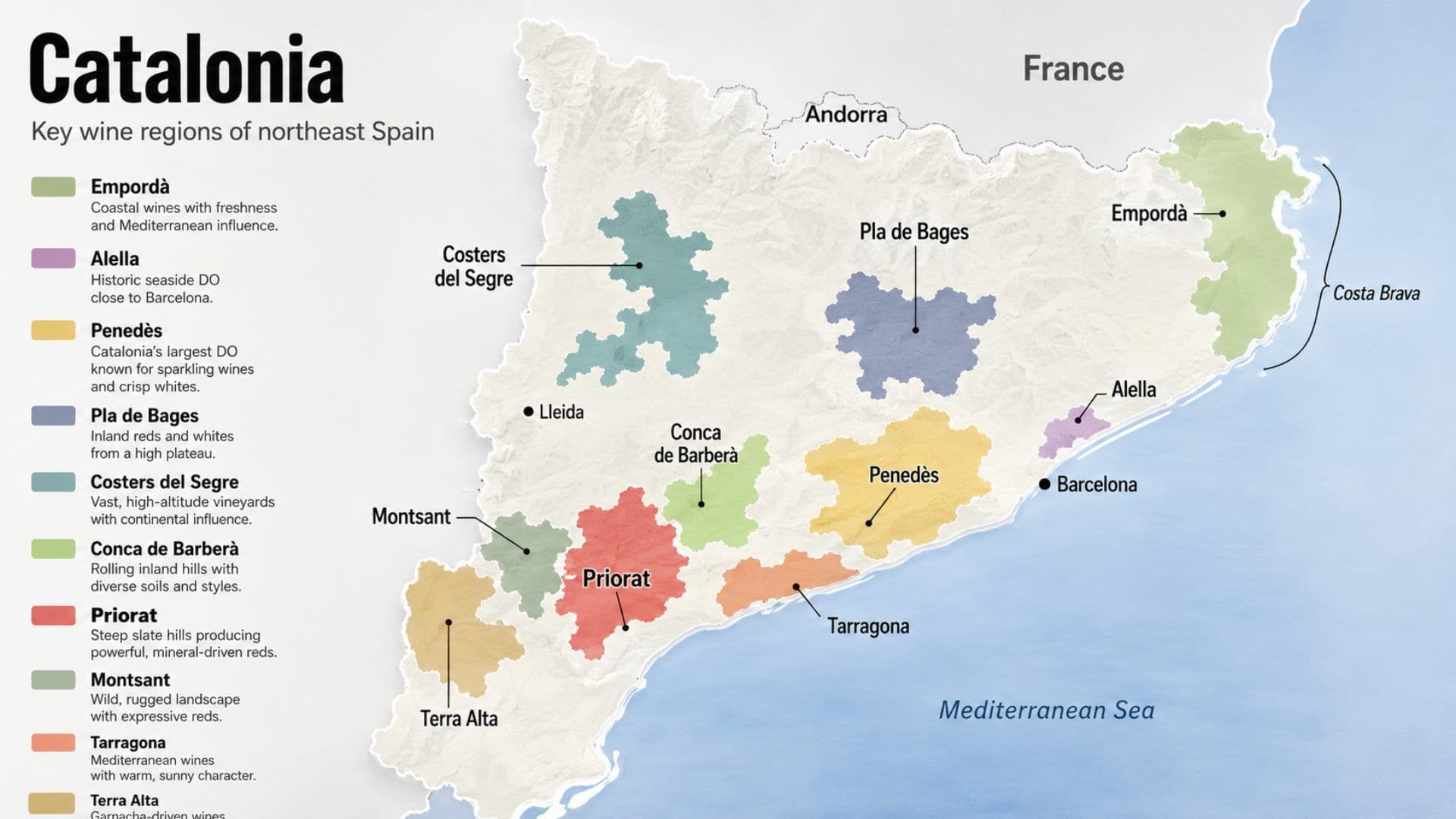
Catalonia's other great contribution is Cava, Spain's traditional-method sparkling wine, born in 1872 when Josep Raventós of Codorníu bottled the country's first. It remains centered on Sant Sadurní d'Anoia in Penedès, though the DO legally spans several regions. Its classic base is a trio of Catalan whites, Macabeo, Xarel·lo, and Parellada, increasingly joined by Chardonnay and Pinot Noir. A 2020 reform reorganized the DO into Cava de Guarda and the longer-aged Cava de Guarda Superior, which rises through Reserva and Gran Reserva to the single-estate Cava de Paraje Calificado. More on that in the next section.
Cava
Catalonia gave Spain not only Priorat but its great sparkling wine. In 1872 Josep Raventós of Codorníu produced the first bottle of what would become Cava in the town of Sant Sadurní d'Anoia, applying the traditional method of a second fermentation inside the bottle, exactly as in Champagne. Unlike most appellations, Cava is defined by technique rather than one contiguous map, though its heartland lies in the Penedès.
 Cava is produced in a number of areas around the nation of Spain, all adhering to similar production standards..
The classic blend draws on three native whites: Macabeo for fruit and a hedge against frost, Xarel·lo for its earthy backbone, and Parellada for delicacy and freshness, with Chardonnay and Pinot Noir permitted since 1986. Quality climbs with time spent aging on the lees, which lends the telltale notes of brioche and toasted almond. Cava de Guarda rests a minimum of nine months, Reserva eighteen, and Gran Reserva thirty, while the elite Cava de Paraje Calificado demands single-estate fruit and at least thirty-six. Frustrated by loose geographic rules, several leading houses broke away to form Corpinnat, a separate mark requiring organic, estate-grown, predominantly indigenous fruit. The finest examples now stand confidently beside grower Champagne.
La Mancha and Valencia
Across the sun-baked plateau south of Madrid lies La Mancha, the largest single wine region on the planet, a land of whitewashed windmills immortalized by Cervantes. Its historic workhorse is Airén, a hardy white grape built by nature to survive brutal drought, long destined for brandy and bulk. The modern center, however, is transforming. Tempranillo, called Cencibel here, now produces supple, affordable reds, and the DO of Valdepeñas has earned a reputation for honest value. Eastward toward the Mediterranean, the province of Valencia tells a parallel story of reinvention.
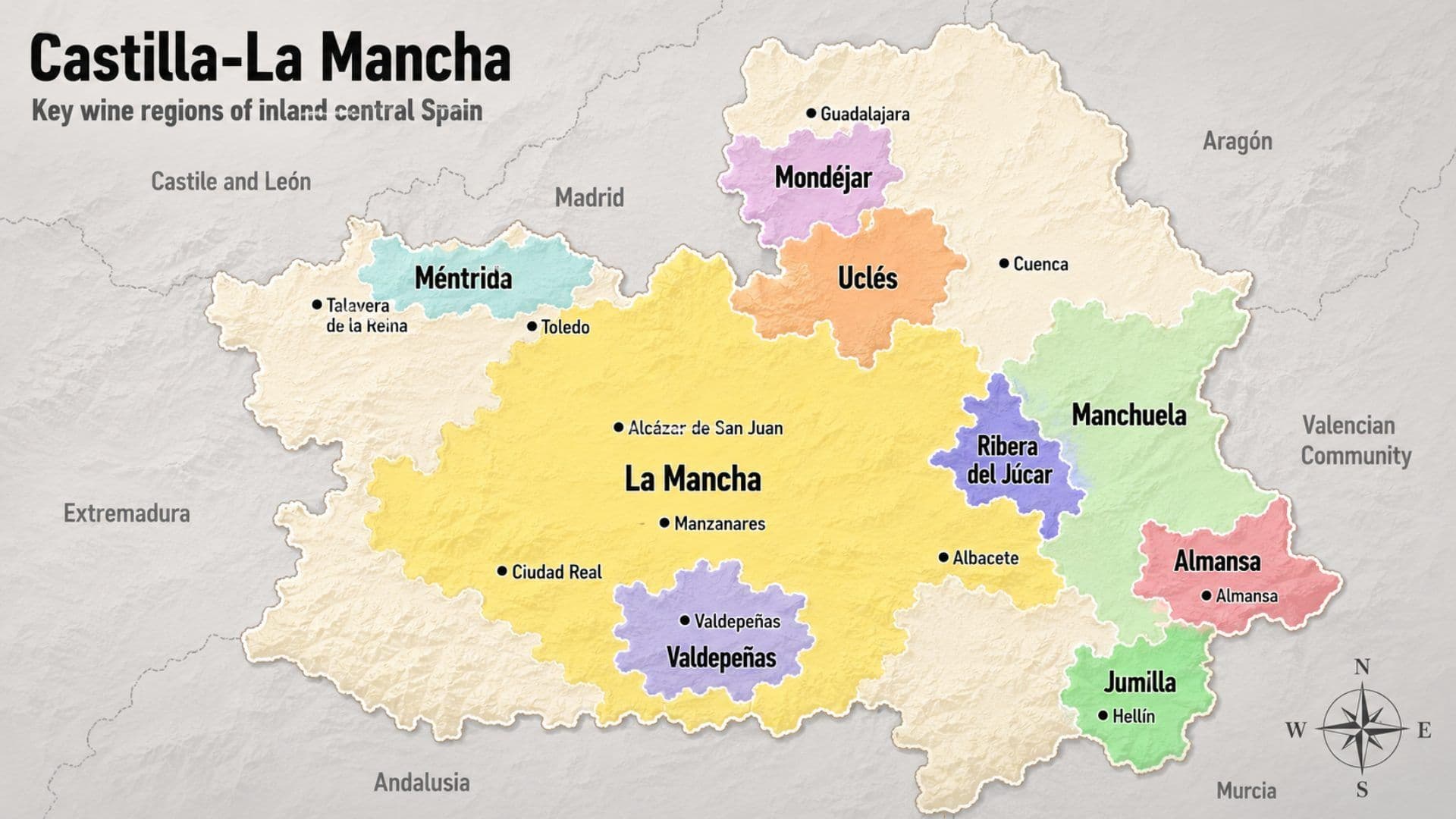
Utiel-Requena stakes its identity on Bobal, Spain's second most planted red grape, capable of deep color and vivid acidity, while Monastrell, the grape the French call Mourvèdre, ripens into warm, brooding wines across the region's warmer fringes. The wide diurnal swing between blistering days and cool nights preserves freshness in the fruit. Once synonymous with large volume, central and eastern Spain have quietly become the country's most exciting source of characterful wines at gentle prices.
Jerez and the Sherry Plains
Spain reserves its most singular creation for the far south, in the sun-struck corner of Andalucía where the fortified wines of Jerez are born. Production is confined to the so-called Sherry Triangle, the towns of Jerez de la Frontera, El Puerto de Santa María, and Sanlúcar de Barrameda, whose vineyards rest on dazzling white albariza, a chalky soil that hoards the winter rains for the parched summer; irrigation is forbidden. The principal grape, Palomino, is fermented dry, lightly fortified, and committed to the solera, a system of fractional blending in which younger wine perpetually refreshes older across stacked tiers of casks. From there two paths diverge.
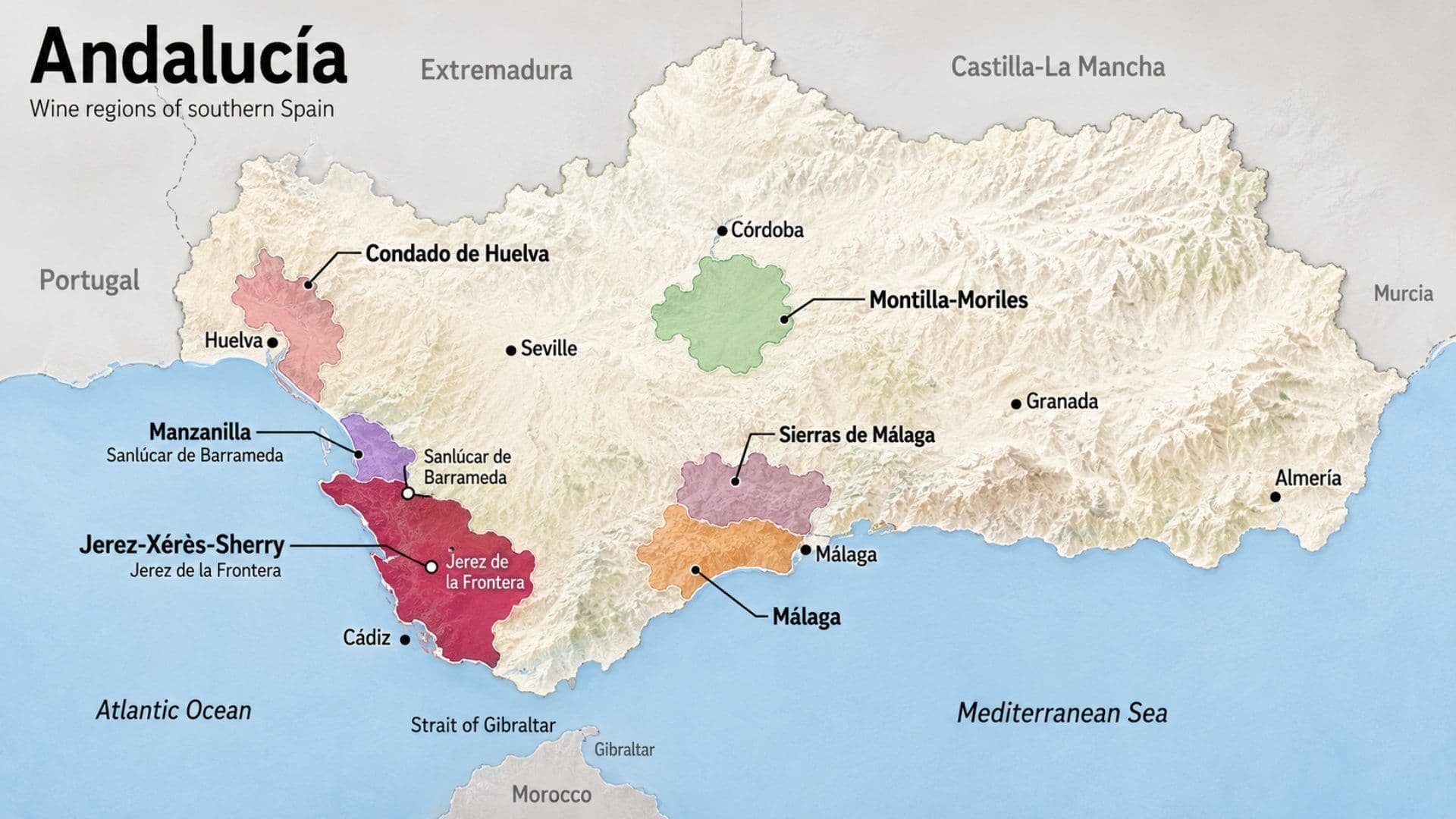
Beneath a living veil of yeast called flor, the wine ages biologically into the bracing, saline styles of Fino and, from Sanlúcar alone, the delicate Manzanilla. Without that veil, oxidative aging yields the nutty Amontillado, the powerful Oloroso, and the rare Palo Cortado. For sweetness, sun-dried Pedro Ximénez gives a near-black elixir of raisin and molasses. The word "sherry" is simply an English softening of Jerez, a reminder of centuries of British devotion to these wines, which remain peerless companions to tapas, jamón, and aged cheese.
In Conclusion
To drink across Spain is to traverse a continent of climates and convictions within a single nation. We began among the elegant, oak-kissed reds of Rioja, journeyed to the muscular Tempranillo of the Duero, scaled the slate terraces of Priorat, raised a glass of patient Cava, uncovered surprising value across the central plateau, and ended before the flor-veiled marvels of Jerez.
What binds these disparate places is not a grape or a style but a temperament, a willingness to honor old vines and ancient methods while pursuing a clear-eyed modern precision. Spain rewards a curious drinker more generously than almost anywhere on earth, because every celebrated region still hides a lesser-known neighbor, a revived variety, or a forgotten hillside waiting to astonish. The glass is only an invitation. The country behind it is, happily, inexhaustible.


