Defining Success: Prosecco Sets the Pace in Sparkling Wine
Fresh, affordable, and dependable, Prosecco built a sparkling wine empire from the hills of northeastern Italy. Its story offers a clear picture of what success means for a wine and the place it comes from.
Prosecco is one of the most popular sparkling wines in the world. It turns up at weddings and brunches, in the spritz glasses of Venice, and on the by-the-glass list of nearly every restaurant that pours bubbles at all. Part of its appeal is simple pleasure, with a light body, soft bubbles, and the scent of green apple, pear, and white flowers. Part of it is price, since a good bottle rarely asks for a special occasion. And part of it is trust, because a glass of Prosecco tends to taste the way people expect it to, wherever they order it.
Its rise also makes Prosecco a useful study in what success looks like for a wine. For more than a century, Champagne set the standard for sparkling wine, and most other regions measured themselves against it. Prosecco took a different path, with a different grape, a faster and less expensive method, and a style built around youthful freshness. Production grew from about 150 million bottles in 2008 to nearly 600 million a decade later, and in 2013 global sales of Prosecco passed Champagne for the first time. Behind those numbers sit a clear set of rules, a hillside heartland that still produces some of Italy's most charming wines, and a lesson about delivering quality at a fair price on a very large scale.
 The famous Prosecco hills are a UNESCO World Heritage Site. The hills of Conegliano and Valdobbiadene received recognition in 2019 for their distinctive cultural landscape, including steep vineyards and a centuries-old pattern of agricultural settlement.
Where Does Prosecco Come From?
Prosecco comes from northeastern Italy, across the Veneto and Friuli Venezia Giulia. The name belongs to a village near Trieste, recorded by an English traveler as early as 1593, and for centuries it was also used for the grape. In 2009, Italy reorganized the whole category. A new Prosecco DOC was drawn across nine provinces, from Treviso and Venice to Udine and Trieste, and the grape was officially renamed Glera so that the word Prosecco would refer only to a place and could be protected like Champagne. The wine must be at least 85 percent Glera, with small amounts of local grapes or Chardonnay and the Pinot family allowed. Labels may add Treviso or Trieste when everything comes from those provinces, and since 2020 a vintage-dated rosé, colored with a splash of Pinot Nero, has joined the range.
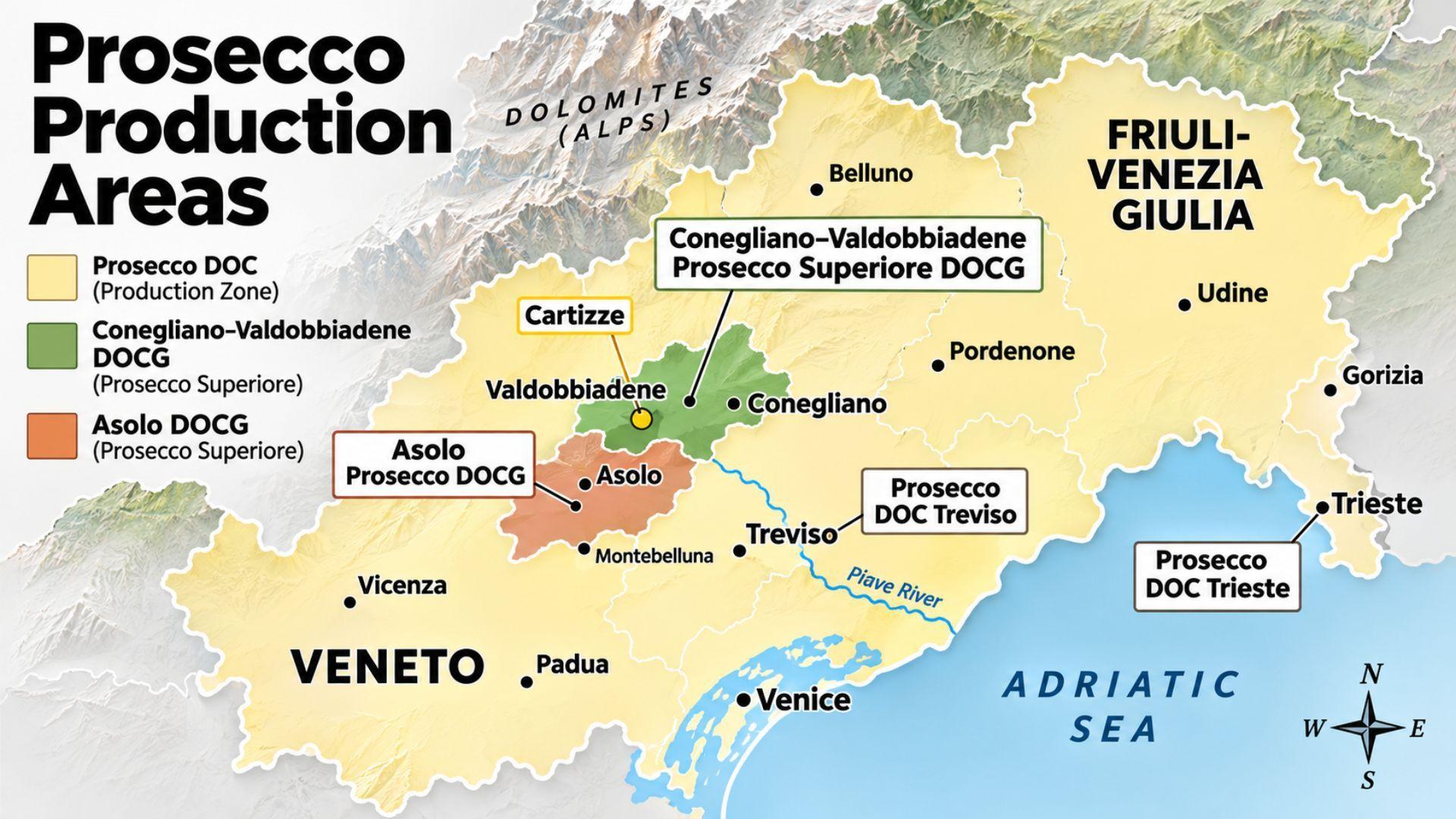
The finest Prosecco comes from the hills. Between the towns of Conegliano and Valdobbiadene, fifteen communes make up the Conegliano Valdobbiadene Prosecco Superiore DOCG, a landscape of steep, narrow ridges where much of the work is still done by hand, added to the UNESCO World Heritage list in 2019. Across the Piave River, the smaller Asolo Prosecco DOCG covers similar hillside country. Within the Conegliano Valdobbiadene zone, 43 Rive name wines from a single commune or hamlet, always vintage-dated and picked by hand, so a bottle can speak of one particular slope. At the top sits Cartizze, a single hill of about 107 hectares above Valdobbiadene shared by roughly 140 growers. Its wines are usually made in the softer, slightly sweeter Dry style, and they are among the most sought-after bottles in the region.
 Prosecco DOC bottled approximately 667 million bottles in 2025. That included roughly 607 million bottles of standard Prosecco DOC and 60 million bottles of Prosecco DOC Rosé, illustrating the enormous scale of the appellation.
Steel Tanks and Fresh Pears
Most Prosecco gets its bubbles in a large steel tank. Italians call the process the Metodo Martinotti, after Federico Martinotti, who developed it in 1895, while much of the world knows it as the Charmat method, after the Frenchman Eugène Charmat, who refined the tank design some fifteen years later. A still base wine of Glera goes into a sealed, pressurized tank with yeast and a little sugar, and the second fermentation traps carbon dioxide in the wine. When the pressure is right, the tank is chilled to stop the yeast, and the wine is filtered and bottled without losing its sparkle.
The process is measured in weeks and months, and the wine spends little time on its spent yeast. What reaches the glass is Glera's own fruit, with green apple, pear, white peach, and acacia blossom, carried by softer, frothier bubbles. Frizzante versions are gentler still, and the old Col Fondo style, refermented in the bottle and left on its sediment, pours slightly cloudy and a little rustic.
Champagne takes a slower road. Its second fermentation happens inside each bottle, and even a non-vintage Champagne must age at least fifteen months before release, twelve of them resting on its yeast. As the spent yeast breaks down, it gives the wine notes of brioche, toast, and roasted nuts, along with a finer, more persistent bead. The cooler climate and the blend of Chardonnay, Pinot Noir, and Meunier add sharper acidity and the structure to age for years. All of that time and handwork shows up in the price. Prosecco is usually at its best within a year or two of the vintage, while good Champagne can keep developing for many years.
 Most Prosecco is produced through secondary fermentation in pressurized stainless steel tanks, known as autoclaves. This method creates natural carbonation while preserving the fresh fruit and floral characteristics associated with Glera.
Consistency Is a Kind of Quality
Success in wine can be measured in more than one way. Champagne and Burgundy measure it in prestige, scarcity, and prices that climb with age. Prosecco measures it in reach, offering a well-made wine that people can order without hesitation, at a price that fits an ordinary evening.
The tank method helps, since it gives winemakers close control over each batch and lets large sparkling houses and cooperatives deliver the same clean, fruity style year after year. That reliability has made Prosecco a natural choice for restaurant wine-by-the-glass lists, where a sparkling wine has to taste right every time a bottle is opened. The aperitivo culture of northern Italy carried it further, as the spritz, built on Prosecco, traveled from Venetian bars to patios around the world. Brands such as Mionetto, which helped bring Prosecco into the American mainstream in 2000, showed how far a dependable style could go.
Protecting the name mattered just as much. The 2009 reform gave Prosecco legal boundaries and a single identity, and the producer consortia for the DOC and for Conegliano Valdobbiadene work to defend that name against imitators abroad. Growth brought hard questions, too. Much of the new planting went onto the flat land of the plains, and some producers in the hills worried that cheap volume would blur the image of the whole category. Their answer was to sharpen the top of the range through the Superiore, Rive, and Cartizze designations, and estates such as Nino Franco and Bisol in Valdobbiadene and Adami in Vidor built reputations on single-vineyard and Rive bottlings.
Prosecco's rise from a regional Italian wine to an international sparkling wine phenomenon is one of the great success stories of the modern wine industry. Its achievements reflect more than an efficient production method or an accessible price point.
A Final Thought
In the end, Prosecco succeeded by doing a few things very well. It offers a clear style, a fair price, and a glass that tastes the same from one bar to the next, all under a name that the law now protects. It also kept a hillside heartland where growers can show what Glera does on a single steep slope. Any wine region could learn from that combination, which pairs a dependable everyday wine with a clear path upward for drinkers who want more.
The label is the easiest way to find that path. Prosecco DOC is the everyday bottle, Conegliano Valdobbiadene or Asolo Superiore steps up in precision, and a Rive or Cartizze names a single place. The sweetness terms run against intuition, since Extra Dry is actually a little sweeter than Brut, and it has long been the classic Prosecco style.
Anyone who prefers a drier glass should look for Brut or Extra Brut. Serve it well chilled, and consider a white wine glass in place of a narrow flute, which many sommeliers prefer because it lets the fruit and flowers come through. Prosecco is at its best young, so there is little reason to cellar it. It shines with fried snacks, cured meats, light seafood, and gently spicy dishes, and it works just as well on its own before a meal.


